Creative Minds 𖹭 Happy Hearts

Diamond Lattice Tile Coloring Page, Nested Squares and Rounded Corners
Pick a single diamond from this diamond lattice tile coloring page and count the layers nested inside it. There are more than you expect, and that is exactly the point.
Each unit in the pattern anchors on a small square center, then expands outward through concentric diamond outlines until it meets its neighbors in a tight interlocking grid. The rounded-corner squares tucked into every gap keep the design from feeling purely angular, giving it a cushioned, almost tactile quality.
Colorists working through this Geometric Designs page will find three distinct zones per repeat: the tiny central square, the stepped diamond rings, and the rounded filler shapes between junctions. The density is high and the fills are narrow, making this a genuinely meditative session rather than a quick one. Color the layers in a gradient within each diamond and the whole surface shifts into something that reads almost three-dimensional.
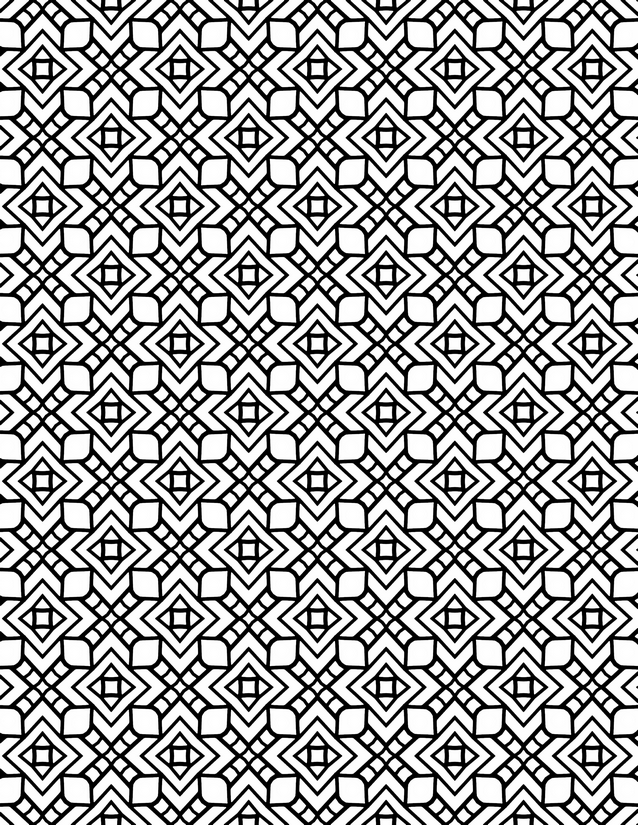
Satisfying repeating geometry fills every corner of this diamond lattice tile coloring page. Free instant download, prints crisp on standard paper.
Best Tools for the Diamond Lattice Tile Coloring Page

Usage Notes
Watercolor pencils applied dry give you the control the tight concentric rings demand, and you can blend outward with a barely damp brush only in the wider filler shapes where there is room. Colored pencils with a sharp point are the workhorse here, handling the narrow diamond bands cleanly without bleeding into neighboring sections. Use alcohol markers cautiously: the larger rounded-corner squares can take a quick pass, but the concentric lines are too close together for a broad brush tip.

Printing Tips
Heavyweight inkjet paper at 90 lb or above prevents the dense linework from feathering if you use any wet media at all. Printing at 100 percent scale preserves the intended line spacing, because scaling down compresses the concentric bands to the point where they almost merge.