Creative Minds 𖹭 Happy Hearts

Observing Tidal Pools Lab Sheet, Rocky Shoreline Ecosystem
Low tide reveals a whole hidden world, and this observing tidal pools lab sheet gives your student the structure to actually document it.
Designed for grades 3 to 6, this observing tidal pools lab sheet walks students through a complete field observation of a rocky shoreline ecosystem. The sheet opens with a focused research question about living and nonliving features in a tidal pool, then guides students through writing a hypothesis, following a six-step procedure, and recording findings in a structured data table that captures where each organism was found, its color, size, and movement, and what adaptations help it survive. A second table covers abiotic features, and tide condition checkboxes at the bottom let students note whether the visit happened at low, rising, high, or falling tide.
This observing tidal pools lab sheet works equally well as a standalone field trip recording tool or as the observational anchor for a broader ocean ecosystems unit study. By the time your homeschooler completes the reflection questions on adaptation and environmental change, they have moved from simple observation into ecological thinking. The built-in safety section makes it easy to send students out with a responsible adult and clear guidelines about not disturbing marine life.
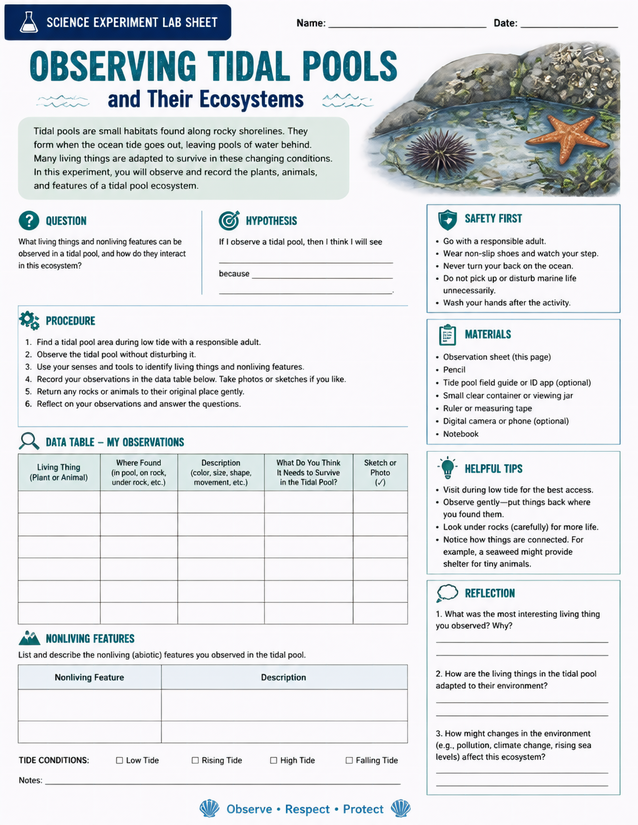
Rocky shoreline science comes alive with this observing tidal pools lab sheet for grades 3 to 6. Includes safety notes and a data table.
Getting Your Homeschooler Started with the Observing Tidal Pools Lab Sheet

Usage Notes
Materials listed on the sheet are almost entirely household or free-to-gather items: a pencil, a notebook, and optionally a ruler, a small clear container, and a phone or camera. A tide pool field guide or identification app is listed as optional but genuinely useful for grades 3 and up. The safety panel is explicit about going with a responsible adult, wearing non-slip shoes, and not picking up or disturbing marine life, so review those notes with your student before heading out.

Printing Tips
Standard copy paper works fine here since students are likely writing in a notebook simultaneously, but 24 lb paper holds up better on a clipboard in damp coastal air. Slip the sheet into a plastic page protector if rain or sea spray is likely, and leave the data tables exposed only when actively writing.