Creative Minds 𖹭 Happy Hearts

Observing Transpiration in Plants Lab Sheet, Plastic Bag Method
Condensation forming inside a sealed bag is the whole lesson. Observing transpiration in plants has never required more than a potted plant, a rubber band, and a few hours of patience.
Structured for grades 3 to 6, this lab sheet walks your student through observing transpiration in plants using nothing more than a clear plastic bag sealed over a leafy branch. The question is printed right at the top: do plants release water vapor into the air? Your homeschooler writes a hypothesis before touching a single material, then follows seven numbered procedure steps that include watering the plant the day before, sealing the bag airtight with a rubber band or twist tie, labeling it with a marker, and placing it in indirect sunlight for one to three hours.
The sheet divides into four working sections: materials, procedure, results, and conclusion. Results prompts ask your student to describe what happened inside the bag over time and what that reveals about the plant. The conclusion section pushes further, asking how transpiration helps the plant and what the stomata explanation at the bottom of the sheet means in their own words. Completed alongside a unit study on plant biology or water cycles, this lab gives your homeschooler a concrete, observable answer to a question that is easy to underestimate.
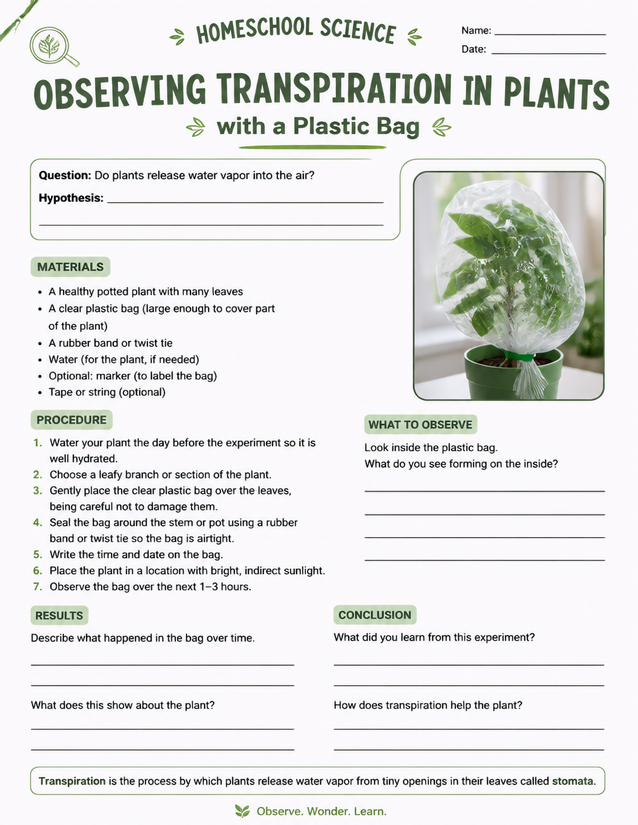
Grades 3-6 homeschoolers test whether plants release water vapor using this observing transpiration in plants lab sheet. Household materials only.
Setting Up Your Observing Transpiration in Plants Lab

Usage Notes
Every item on the materials list is a household supply: a healthy potted plant with plenty of leaves, a clear plastic bag large enough to cover a branch, a rubber band or twist tie, and optional tape, string, or a marker for labeling. No specialty science supplies are needed. The only safety note implied by the procedure is handling the plant gently when placing the bag to avoid damaging leaves or stems.

Printing Tips
Sixty-pound text weight or standard 20 lb copy paper both hold up fine here since students write during a waiting period rather than mid-handling. Print one sheet per student and keep it loose on a clipboard near the plant so your homeschooler can check the bag and jot observations without moving anything.