Creative Minds 𖹭 Happy Hearts

Testing the Accuracy of Different Thermometers, Homeschool Lab Sheet
Three cups, three temperatures, and up to three thermometers reveal exactly which one your student should trust. Testing the accuracy of different thermometers makes measurement error visible and concrete.
Your student sets up ice water, room temperature air, and warm water environments, then records readings from each thermometer alongside a reliable reference thermometer. The error calculation row (Measured Temperature minus Reference Temperature) makes the math explicit, and the data table accommodates up to three thermometers simultaneously. Designed for grades 4-7 homeschoolers, this experiment builds real fluency with scientific measurement rather than just reading a number off a scale.
Testing the accuracy of different thermometers fits naturally into a measurement and instrumentation unit or alongside a broader physics or chemistry sequence covering heat and temperature. Completed independently, it still demonstrates a full experimental cycle: hypothesis, controlled procedure across three test points, quantitative error analysis, and a written conclusion. The analyze-your-results section pushes your student to explain why accuracy varied, which is where the real thinking happens.
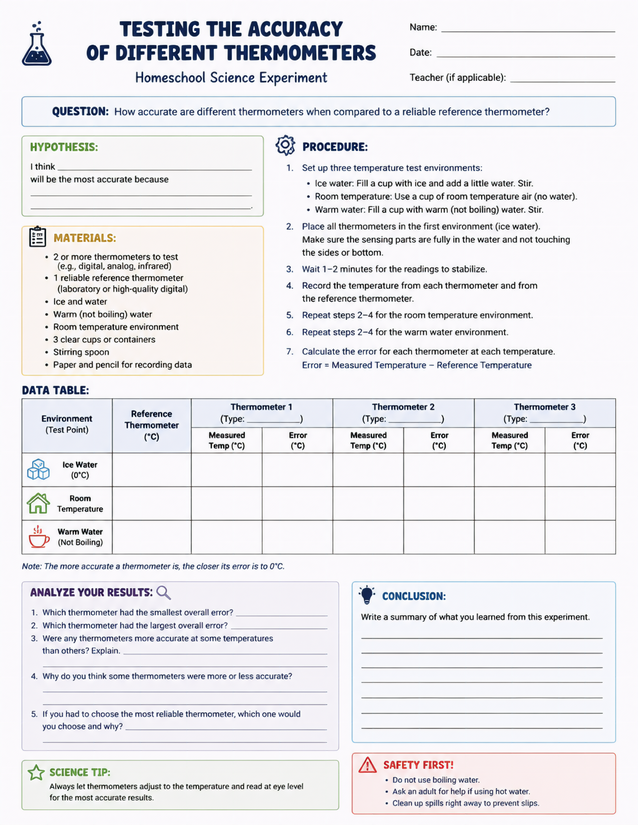
Grades 4-7 homeschoolers compare thermometer readings across three temperature environments with this testing the accuracy of different thermometers lab sheet.
Recording Results for Testing the Accuracy of Different Thermometers

Usage Notes
Household items cover almost everything here: ice, water, cups or containers, a stirring spoon, and paper and pencil. The one specialty item is a reliable reference thermometer, described on the sheet as laboratory or high-quality digital, which your homeschool science kit likely already includes. Warm water is used rather than boiling, and the safety section explicitly reminds students not to use boiling water and to ask an adult when handling hot water.

Printing Tips
A single loose sheet on a clipboard keeps the data table flat and easy to write on while your student moves between the three test environments. Twenty-four-pound paper holds up fine for one-time use, but if your homeschooler runs this experiment more than once with different thermometer sets, a laminated copy with a dry-erase marker lets you reuse the observation and data sections without reprinting.