Creative Minds 𖹭 Happy Hearts

Testing the Effect of Acid Rain on Plant Growth, Data Table Included
Vinegar-spiked water versus normal rain, tracked over 14 days. This acid rain on plant growth lab gives your student a controlled comparison they can actually measure.
Structured for grades 5-8, this acid rain on plant growth lab walks your student through a full scientific investigation using two potted plants and a homemade acid solution made from white vinegar and water. The sheet includes a labeled hypothesis prompt, a materials list, step-by-step procedure, and a pH guide showing where the vinegar mixture falls on the scale. A 14-day data table asks students to record average plant height in centimeters every two days for both the acid rain pot and the normal rain pot, alongside daily observations on color, leaf size, and wilting.
Four analysis questions at the bottom push beyond data recording, asking your student to explain what caused the differences they observed and connect findings to real-world environmental impact. As a standalone lab or part of a broader earth science or ecology unit study, this sheet demonstrates that your homeschooler can design a fair test, maintain consistent variables, and draw a conclusion from collected evidence.
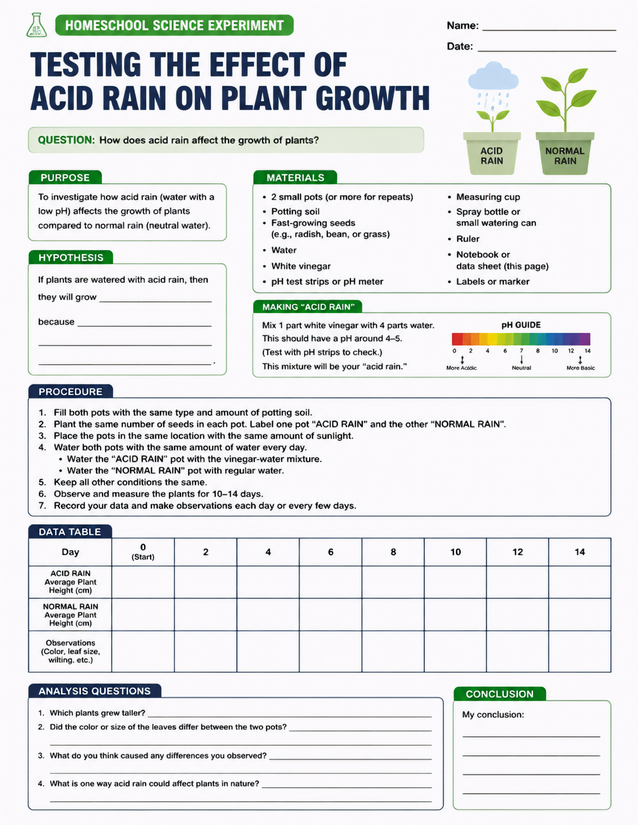
Structured homeschool experiment recording the acid rain on plant growth lab for grades 5-8, with data table and analysis questions included.
Investigating the Acid Rain on Plant Growth Lab, Start to Conclusion

Usage Notes
Nearly every material on this sheet is already in your kitchen or pantry. White vinegar, water, potting soil, and fast-growing seeds such as radish or grass seed are all household or easily sourced items. pH test strips are the one specialty supply worth having on hand before your student starts, and the sheet reminds you to test the vinegar-water mixture to confirm a pH of around 4 to 5. No safety concerns beyond careful labeling of the two pots to prevent mix-ups during the 10 to 14 day observation window.

Printing Tips
Slip one copy into a clear sheet protector inside your science lab notebook so the procedure stays readable while your student writes directly on a second copy during daily measurements. A heavier copy paper, 24-pound or above, holds up better if the sheet is handled repeatedly near watering supplies.