Creative Minds 𖹭 Happy Hearts

Effect of Different Exercises on Breathing Rate Lab Sheet
Jumping jacks versus sitting still: your student records the effect of different exercises on breathing rate and watches the numbers tell the story.
Built around the question of how movement changes respiration, this lab sheet guides grades 4-6 homeschoolers through a structured investigation into the effect of different exercises on breathing rate. Students establish a resting baseline, perform at least three self-chosen exercises for two minutes each, and log breaths per minute before and after each one in a clearly formatted data table that also calculates the change between resting and active rates.
The sheet fits naturally into a human body unit study covering the respiratory or cardiovascular system, and it works just as well as a standalone experiment for a light science day. By the time your student reaches the analysis and conclusion sections, they are reasoning about exercise intensity, not just counting breaths, which makes this a solid demonstration of both data collection and basic scientific inference.
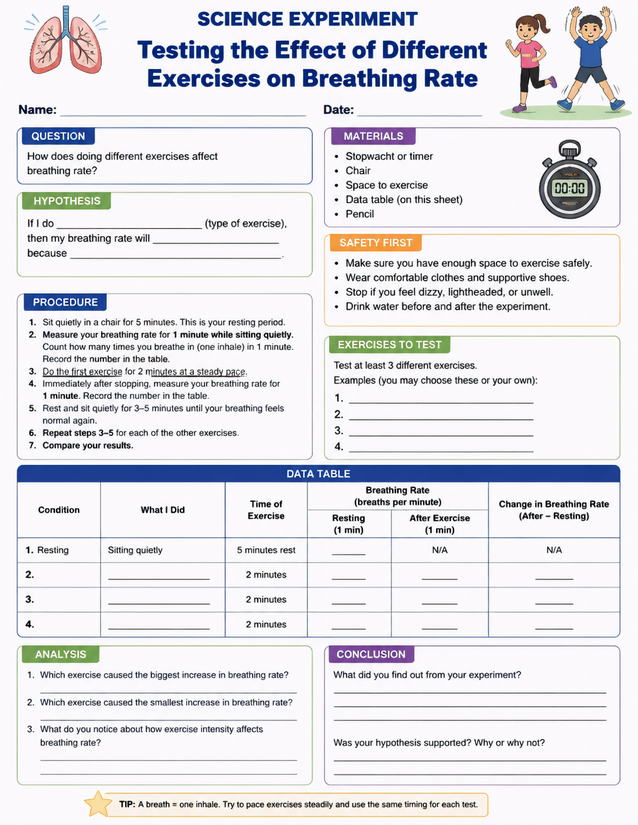
Record the effect of different exercises on breathing rate with this grades 4-6 homeschool science lab sheet. All sections included.
Investigating the Effect of Different Exercises on Breathing Rate

Usage Notes
Everything on the materials list is already in most homes: a chair, a stopwatch or phone timer, and a pencil. No specialty supplies are needed. The safety section on the sheet reminds students to have enough space to move, wear supportive shoes, stop if they feel dizzy, and drink water before and after, so read those notes with your homeschooler before starting.

Printing Tips
Regular copy-weight paper works fine here since students write during rest intervals rather than mid-exercise. Punch two holes and slip it into a science binder, or keep it loose on a clipboard so your student can carry it around during the active portions of the experiment.