Creative Minds 𖹭 Happy Hearts

Fertilizers on Bean Plant Yield Lab Sheet, Grades 5, 7
Compost, fish emulsion, or all-purpose fertilizer: which one actually moves the needle? This lab sheet walks your student through testing how fertilizers on bean plant yield compare, from seed to harvest.
Your student plants identical bean seeds into four or five pots, applies a different fertilizer to each, and tracks plant height, pod count, and total dry bean mass over several weeks. The sheet includes a structured data table with a control pot labeled ‘No Fertilizer,’ a graph section for plotting total dry mass by treatment, and five analysis questions that ask students to evaluate results and consider sources of error. Designed for grades 5, 7, this homeschool worksheet builds real skills in experimental design, variable control, and data interpretation.
The lab fits naturally into a botany or soil science unit study and works as a standalone multi-week investigation when you have space for five pots on a sunny windowsill or outside. By the time your student fills in the conclusion section, they have practiced writing a supported claim tied to evidence from their own data. Completing the full sheet demonstrates that your homeschooler understands how fertilizers on bean plant yield connect to broader concepts in plant nutrition and controlled experimentation.
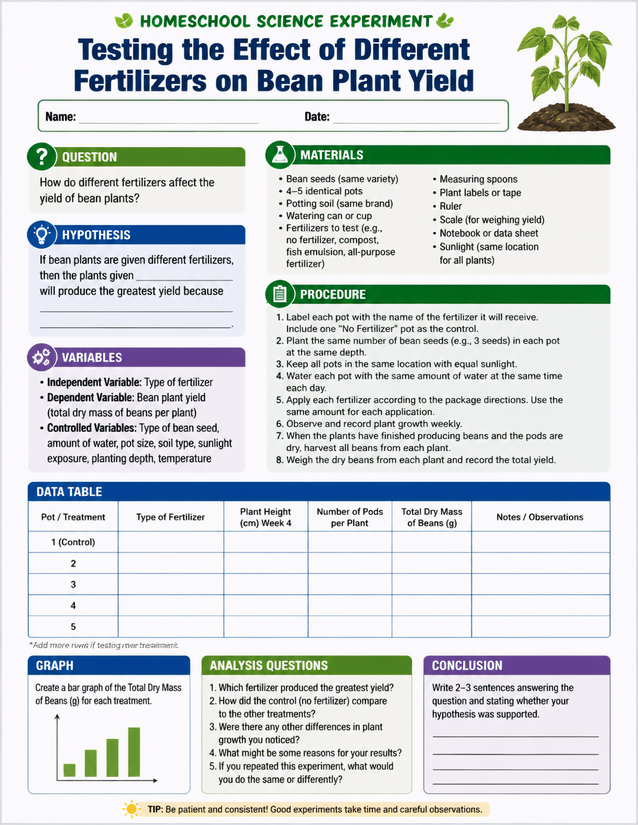
Grades 5, 7 homeschoolers compare how fertilizers on bean plant yield vary across compost, fish emulsion, and all-purpose types. Download free.
Exploring Fertilizers on Bean Plant Yield in Your Homeschool Lab

Usage Notes
Bean seeds, potting soil, and identical pots are the core supplies, and most homeschool families can source all three locally without specialty ordering. The fertilizers themselves are the only variable purchase: the sheet names compost, fish emulsion, and all-purpose fertilizer as examples, so you choose what is available. Students will handle fertilizer concentrates, so a brief reminder about washing hands after application is worth adding to your pre-lab conversation.

Printing Tips
Clip a single copy to a clipboard so your student can carry it to wherever the pots are kept and record observations directly. Because the data table runs across several weeks, 24-pound paper holds up better than standard copy weight if the sheet will see repeated handling near water and soil.