Creative Minds 𖹭 Happy Hearts

Effect of Different Liquids on Tooth Decay, Eggshell Experiment
Five cups, five liquids, one eggshell each. Studying the effect of different liquids on tooth decay has never been this tangible or this easy to set up on a kitchen counter.
Your student places a whole egg into each of five clear cups, then covers them with water, milk, white vinegar, lemon juice, and soda cola respectively. After 48 hours, they observe the eggshell color, texture, and feel, recording each result in the structured observations table. Because eggshell calcium carbonate closely mirrors tooth enamel, this experiment gives grades 4-6 homeschoolers a concrete, visual model of acid erosion that a diagram never quite delivers. The sheet walks them through question, hypothesis, step-by-step procedure, and a think-further prompt asking how teeth can be protected from decay.
The effect of different liquids on tooth decay fits naturally into a health and nutrition unit study or alongside a body systems sequence covering the digestive tract. Completed alone, it still stands as a self-contained two-day experiment with a clear before-and-after comparison. When your student fills in the conclusion section, they are not just summarizing observations, they are making a real-world inference connecting food chemistry to oral health, a skill that anchors scientific reasoning at the upper elementary level.
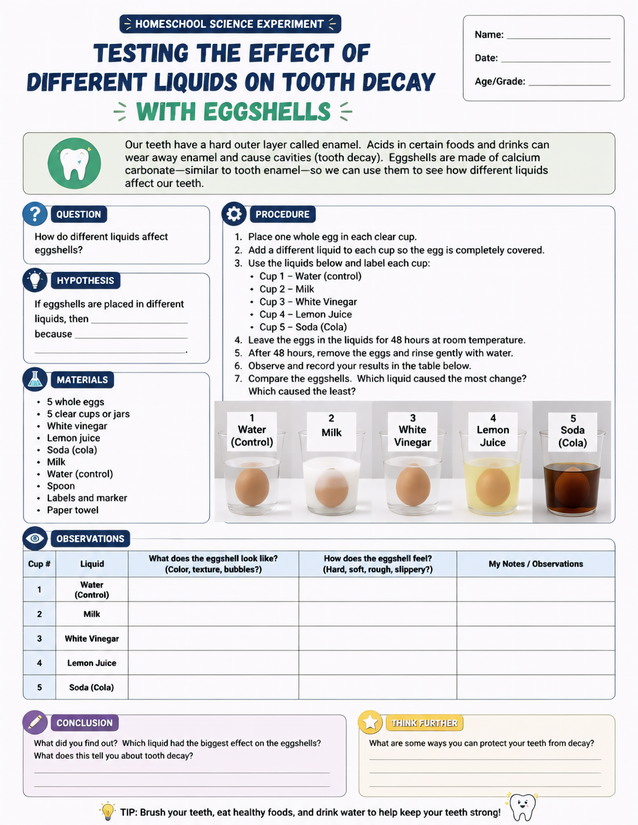
Grades 4-6 homeschoolers investigate the effect of different liquids on tooth decay using eggshells, vinegar, soda, and milk over 48 hours.
Setting Up the Effect of Different Liquids on Tooth Decay Experiment

Usage Notes
All five materials are standard household items: whole eggs, white vinegar, lemon juice, soda, milk, and water. No specialty supplies or heat sources are required, though students should handle the eggs carefully to avoid cracks before the experiment begins. The sheet implies rinsing eggs after 48 hours, so remind your homeschooler to do that step over a sink rather than the observation table.
Printing Tips
Standard 20 lb copy paper handles the writing load here, but 24 lb gives the observation table a bit more body if your student presses hard with a pencil. Punch holes and slip it into a dedicated science lab notebook so the completed sheet stays paired with any photos your student takes of the five cups at the 48-hour mark.