Creative Minds 𖹭 Happy Hearts

Music Genres on Mood and Heart Rate Lab Sheet
Headphones on, stopwatch ready: this lab turns a playlist into data by measuring how music genres on mood and heart rate actually shift from genre to genre.
Your student listens to three or four music genres, including Classical, Pop, Rock, Hip-Hop, Jazz, and Lo-Fi, then records heart rate before and after each five-minute listening session alongside mood ratings across five categories: Happy, Calm, Energetic, Sad, and Anxious. The sheet walks grades 5-8 homeschoolers through a full scientific method cycle, from writing a hypothesis about how music genres on mood and heart rate will change, to filling a structured data table, to answering six targeted analysis questions.
As a standalone unit study addition or a natural companion to a body systems or psychology unit, this lab demonstrates that quantitative data and subjective self-reporting can coexist in the same experiment. Completing it asks your student to identify patterns across multiple variables, draw evidence-based conclusions, and respond to an open-ended critical thinking prompt about volume and listening duration.
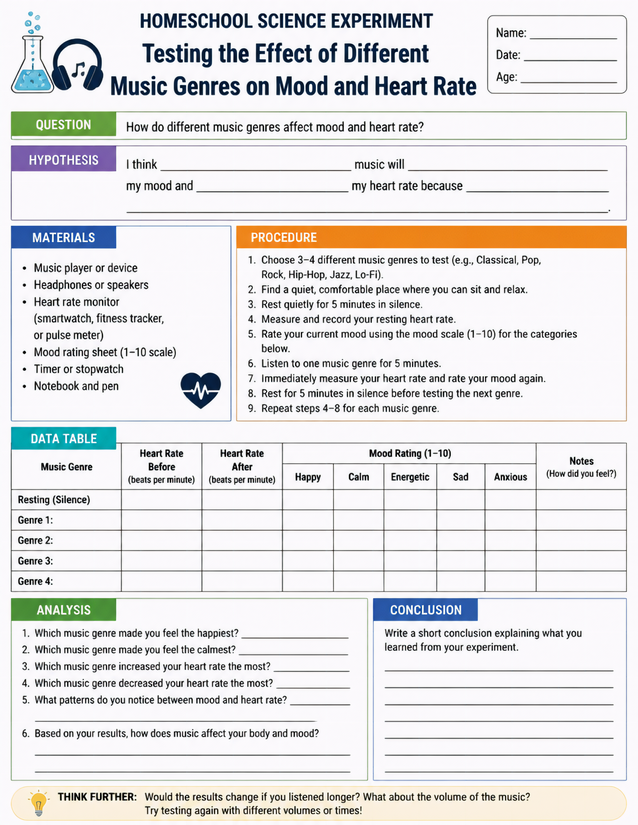
Measure how music genres on mood and heart rate compare across Classical, Pop, Rock, and more. Grades 5-8 homeschool science experiment.
Recording Results for Music Genres on Mood and Heart Rate

Usage Notes
A music player or device, headphones or speakers, and a heart rate monitor such as a smartwatch, fitness tracker, or pulse meter are listed on the sheet. All materials are household or low-cost consumer items, with the heart rate monitor being the one specialty piece your student will need access to. No safety concerns are implied beyond sitting quietly and using comfortable listening volume.

Printing Tips
Standard copy paper works for a single use, but 24 lb paper holds up better if your student rests a wrist or arm on the sheet while recording readings mid-experiment. Tuck it into a science lab notebook after the experiment is complete so the data table stays intact alongside the conclusion.