Creative Minds 𖹭 Happy Hearts

Effect of Exercise on Heart Rate Lab Sheet
Jumping jacks, a stopwatch, and a pulse to count: the effect of exercise on heart rate becomes something your student can actually measure, record, and explain in a single session.
Your student begins by resting quietly for five minutes, records a baseline pulse, then performs three minutes of activity such as jumping jacks, running in place, or fast-paced dancing. The data table captures heart rate immediately after stopping, then at one, two, and three minutes post-exercise, giving a clear recovery curve to analyze. This lab suits grades 4-7 and brings the effect of exercise on heart rate out of the textbook and into lived experience.
The sheet moves from hypothesis through procedure, data collection, analysis, and a written conclusion, so it functions as a complete standalone lab within a human body or health unit study. Analysis questions ask your student to identify resting rate, peak rate, and how long recovery took, which builds data interpretation skills alongside the biology content. Completing it demonstrates that your homeschooler can design, run, and draw conclusions from a controlled personal experiment.
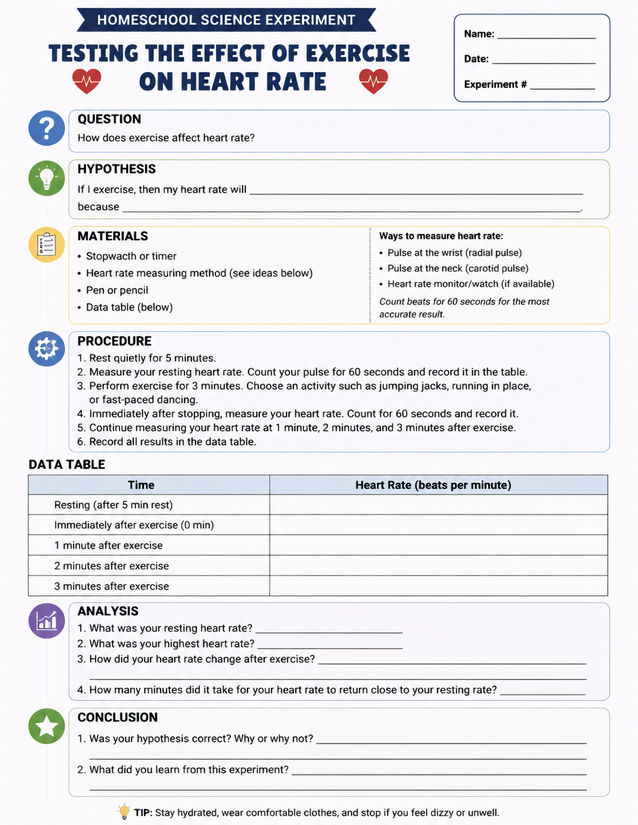
Record and analyze the effect of exercise on heart rate with this grades 4-7 homeschool science experiment sheet. Instant download.
Investigating the Effect of Exercise on Heart Rate in Your Homeschool Lab

Usage Notes
A stopwatch or timer is the only item that might not already be on hand, and most phones cover that. Students measure pulse at the wrist or neck using a finger, or with a heart rate monitor if available. The tip at the bottom of the sheet explicitly flags safety: students should stay hydrated, wear comfortable clothes, and stop immediately if dizzy or unwell.

Printing Tips
A single copy on 20 or 24 lb paper slips easily into a lab notebook beside the student’s notes. Keep it as a loose sheet on a clipboard if your student is moving around the room during the exercise phase, since writing on a flat surface mid-experiment is easier than flipping through a binder.