Creative Minds 𖹭 Happy Hearts

Gravity Effect on Plant Root Growth Lab Sheet
Two clear containers, one upright and one tipped on its side, reveal something surprising about how gravity effect on plant root growth actually works at the cellular level.
Your student plants fast-growing seeds such as radish, bean, or mung bean in two identical containers, keeping one upright as the control and laying the second on its side as the test group. Over five to seven days, they record root direction daily in a structured observation table, sketching what they see in each container. This gravity effect on plant root growth lab is written for grades 4 through 6 and introduces the concept of gravitropism through direct, observable comparison rather than reading alone.
The sheet fits naturally into a plant biology or earth science unit study and works as a standalone investigation without requiring any prior experiment in the sequence. By the time your homeschooler fills in the conclusion prompts, they have moved from forming a hypothesis to interpreting real data, and can explain in their own words why roots in the tilted container still grew downward relative to gravity rather than relative to the container wall.
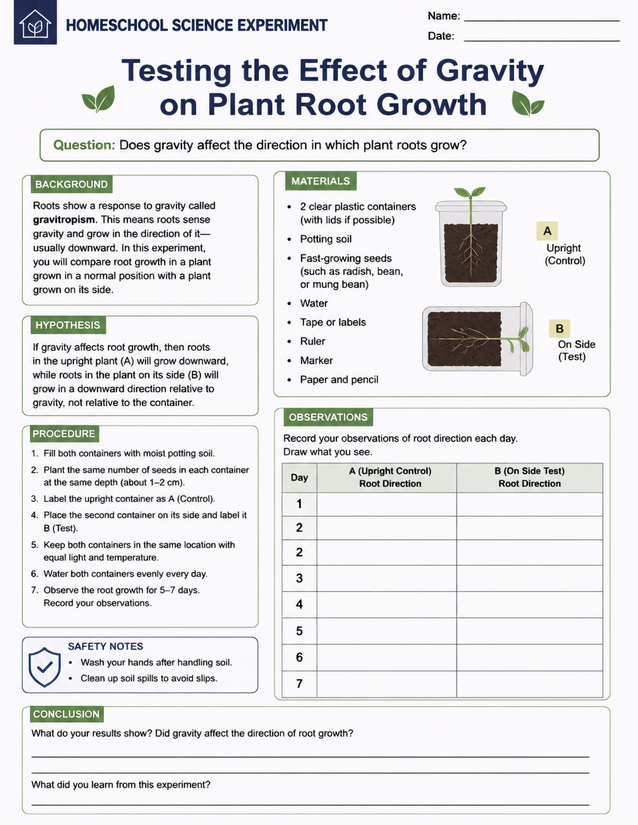
Explore the gravity effect on plant root growth with this homeschool experiment for grades 4-6. Fast-growing seeds included.
Investigating the Gravity Effect on Plant Root Growth

Usage Notes
Everything on the materials list is a household or grocery store item. Two clear plastic containers with lids, potting soil, fast-growing seeds, water, tape, a ruler, a marker, and paper and pencil are all that is needed. No specialty supplies are required, though the sheet notes washing hands after handling soil and cleaning up spills to prevent slips.

Printing Tips
Copy paper handles pencil sketching in the observation table well enough for a single-use sheet, but 24 lb paper holds up better if the sheet will sit near a watering area for a week. Slip it into a plastic page protector inside a lab notebook so daily entries stay dry and the sheet travels between the experiment station and your student’s binder without wrinkling.