Creative Minds 𖹭 Happy Hearts

Light Wavelength on Plant Growth Lab Sheet, 14-Day Experiment
Five colored grow lights, five pots, and fourteen days of data collection: the light wavelength on plant growth lab gives your student a front-row seat to one of botany’s most surprising variables.
Structured for grades 5-7, this lab sheet walks your student through a controlled experiment comparing how red, blue, green, yellow, and white light each affect seedling height over a two-week period. The sheet opens with a guided hypothesis prompt, moves through an eight-step procedure, and closes with a data table organized by day and light color, plus four analysis questions that push beyond the numbers into reasoning about why plants respond differently to each wavelength.
The light wavelength on plant growth lab works well as a standalone unit or as a capstone to a botany or physics-of-light unit study. By the end, your homeschooler has practiced controlling variables, measuring from soil surface to plant tip, and drawing a conclusion supported by their own recorded data, skills that build directly toward more advanced lab work.
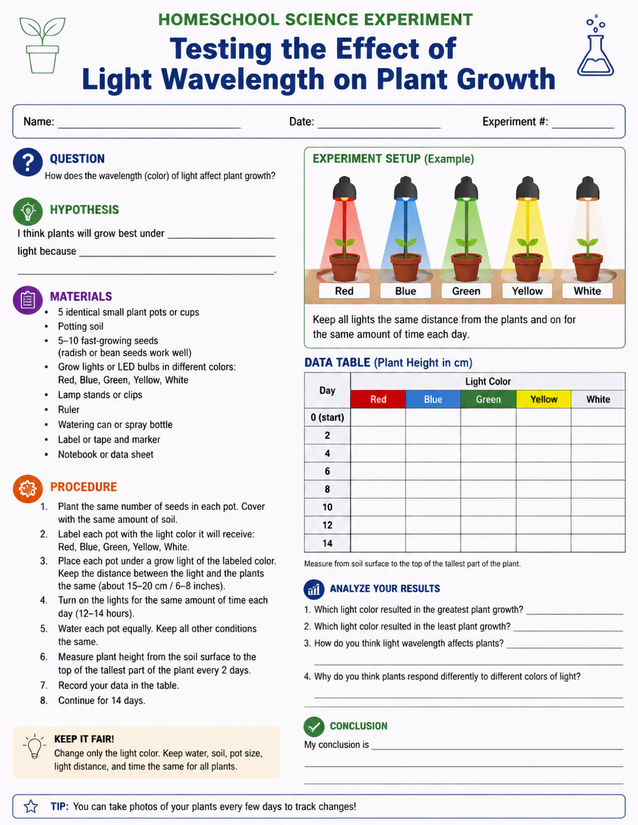
Your grades 5-7 student tests red, blue, green, yellow, and white light in this light wavelength on plant growth lab over fourteen days.
Recording Results for the Light Wavelength on Plant Growth Lab

Usage Notes
Fast-growing seeds like radish or beans are listed on the materials section, making this experiment accessible without a specialty seed order. Five grow lights or colored LED bulbs are required, which may need to be sourced ahead of time. The sheet reminds students to keep all other variables identical, so lamp stands or clips that hold bulbs at a consistent 15-20 cm distance are worth gathering before day one.

Printing Tips
A 24-pound paper holds up to two weeks of pencil entries in the data table without ghosting through. Clip it to a dedicated lab folder or science notebook so daily measurement notes stay together with the recorded table for easy review at the end of the fourteen days.