Creative Minds 𖹭 Happy Hearts

pH Effect on Plant Growth with Different Soils Lab Sheet
Nine pots, three soil types, three pH levels: watching the pH effect on plant growth play out over three weeks tells your student more than any textbook paragraph could.
This lab sheet walks grades 5-7 students through a structured investigation of how soil pH changes the way plants take up nutrients and grow. The experiment uses potting soil, garden soil, and sandy soil, each adjusted to acidic, neutral, and alkaline conditions using vinegar or baking soda. Students fill in a hypothesis, record actual pH after adjusting, and then track plant height in centimeters on days 3, 7, 10, 14, and 21, adding leaf color and growth observations in the final column.
The pH effect on plant growth becomes visible across the data table as your student compares nine rows of daily measurements side by side. Four analysis questions at the bottom push beyond data recording and into interpretation: which pH produced the best growth, how the soils responded differently, and what those results suggest about garden planning. The sheet works as a standalone three-week unit or as the capstone experiment in a soil science or botany study.
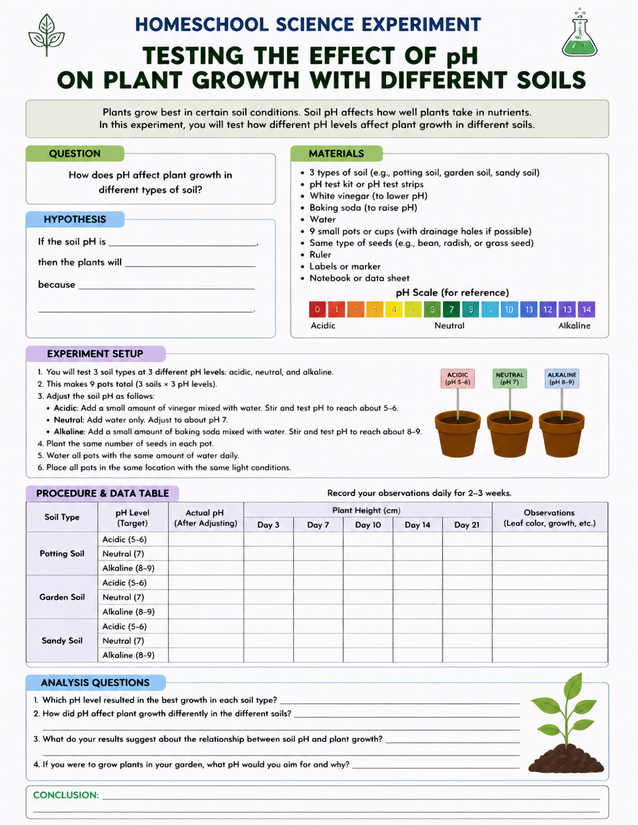
Grades 5-7 homeschoolers record how pH effect on plant growth varies across potting, garden, and sandy soil types. Instant download.
Setting Up Your pH Effect on Plant Growth Experiment

Usage Notes
Everything on the materials list is household-accessible. Vinegar and baking soda adjust the pH, and pH test kit strips or pH test paper confirm the level before planting. Nine small cups or pots with drainage holes, seeds (bean, radish, or grass all work), a ruler, and a notebook are the only other items needed. No specialty lab supplies are required, though adult supervision is recommended when students are mixing vinegar solutions near seeds.

Printing Tips
Copy-weight paper works fine for pencil entries, but 32-pound paper holds up better if the sheet will sit next to watered pots for three weeks. A clipboard keeps the sheet accessible for daily check-ins without punching holes in it mid-experiment.