Creative Minds 𖹭 Happy Hearts

Testing the Effect of Stress on Plant Growth, Lab Sheet
Bean seedlings versus drought, bent stems, or dim light: recording the effect of stress on plant growth gives your student real data to defend a conclusion, not just a hunch.
Structured for grades 5-7, this lab walks students through a controlled comparison between a no-stress plant and one subjected to a chosen stressor, such as reduced water, excess water, low light, physical damage, or salty soil. Students write a hypothesis, identify independent and dependent variables, measure plant height in centimeters each day for up to ten days, and log daily observations about color changes, drooping, or other visible differences. The data table holds columns for a control plant, a primary stress plant, and an optional second stress type so your homeschooler can extend the experiment without redesigning the sheet.
The effect of stress on plant growth is a natural fit inside a botany unit study or a broader environmental science sequence. Completed alone, it demonstrates experimental design skills including variable control and data collection. As part of a sequence, it pairs well with soil pH or fertilizer experiments already in your curriculum. The conclusion section pushes students past observation by asking what the results reveal about how stress affects plants and whether the original hypothesis held up, moving them from recording facts to building an argument.
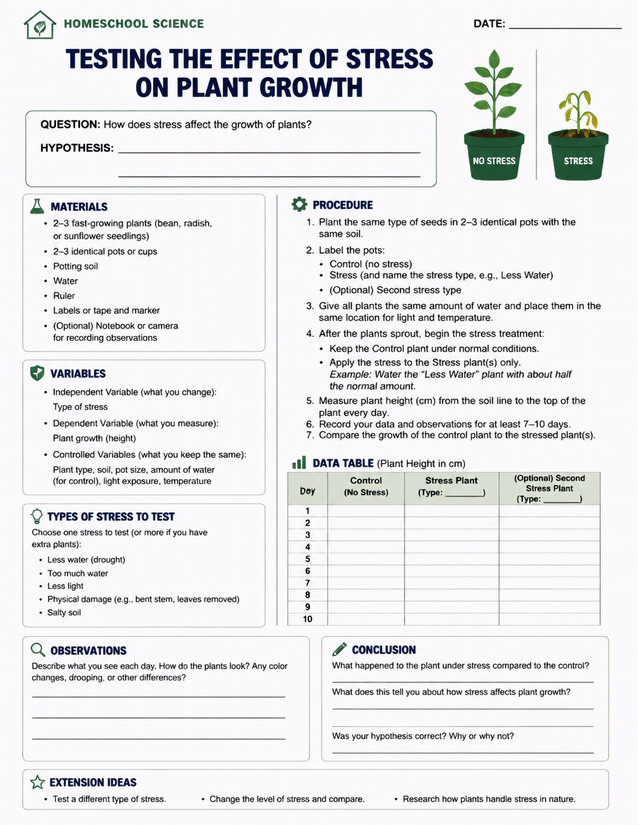
Grades 5-7 homeschoolers investigate the effect of stress on plant growth across ten days using beans, radishes, or sunflowers. Download free.
Investigating the Effect of Stress on Plant Growth Over Ten Days

Usage Notes
Bean, radish, or sunflower seedlings are the only living materials required, and everything else on the list is standard household supply: identical pots or cups, potting soil, water, a ruler, and labels or tape. No specialty equipment is needed. If your student chooses the salty soil stress treatment, keep it away from other plants to avoid accidental cross-contamination of your growing area.
Printing Tips
Cardstock is not necessary here, but 28-pound paper holds up better than standard copy weight when students rest the sheet on a clipboard and write daily measurements with a pencil. Hole-punch the finished sheet to drop it straight into a science lab notebook once the ten days are complete.