Creative Minds 𖹭 Happy Hearts

Natural Antibiotics Effectiveness Lab Sheet, Grades 6-8
Garlic versus oregano oil versus raw honey, which one actually slows bacteria? Your student finds out with this natural antibiotics effectiveness lab sheet and a set of agar plates.
Students in grades 6-8 test six natural substances, garlic, raw honey, turmeric, tea tree oil, oregano oil, and distilled water as a control, by placing sterile paper discs soaked in each substance onto pre-poured agar plates and measuring the zone of inhibition around each disc in millimeters after 24 to 48 hours of incubation. The natural antibiotics effectiveness lab sheet walks through question, hypothesis, procedure, data table with two trials per substance, observations, and a written conclusion about which substance performed best.
This lab fits naturally into a microbiology, health science, or natural remedies unit study and pairs well with lessons on how antibiotics work at the cellular level. Completing it asks your homeschooler to practice sterile technique, read calipers or a ruler for precise measurement, and interpret a data table before forming an evidence-based argument in the conclusion section, skills that move well beyond basic observation into genuine scientific reasoning.
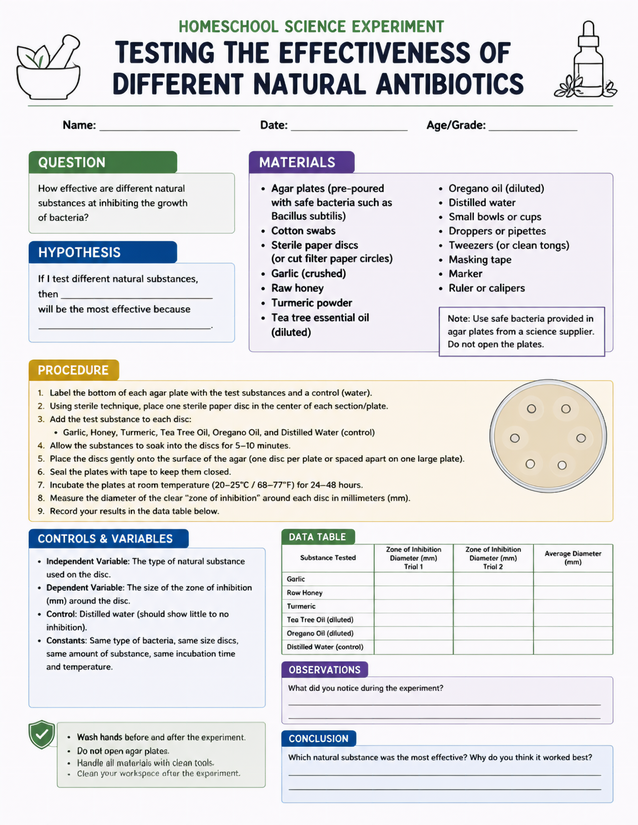
Garlic, honey, turmeric, and essential oils face off in this natural antibiotics effectiveness lab sheet for grades 6-8 homeschoolers.
Getting Started with the Natural Antibiotics Effectiveness Lab Sheet

Usage Notes
Agar plates pre-poured with safe bacteria such as Bacillus subtilis are specialty supplies typically ordered from a science supplier, and the sheet includes a safety note reminding students not to open the plates. Garlic, raw honey, turmeric, small cups, cotton swabs, masking tape, a marker, and a ruler are all household items. Tweezers or clean tongs, sterile paper discs, and diluted essential oils require a short supply run but are inexpensive.

Printing Tips
A single loose sheet on a clipboard works well during the 24 to 48 hour incubation window when your student returns to measure and record results across two trials. Standard 20-pound copy paper is fine since writing loads are light, but slipping the sheet into a plastic page protector keeps it clean if the workspace is near the agar plates.