Creative Minds 𖹭 Happy Hearts

Natural Weed Killers Lab Sheet, Seven-Day Observation
Five treatments, one winner, and seven days of daily observation: this natural weed killers lab sheet walks your student through a real controlled experiment using nothing but kitchen and garden supplies.
Students test whether white vinegar, boiling water, salt water, or dish soap solution outperforms a plain water control at damaging or killing potted weeds. The sheet structures every stage: a written hypothesis, a labeled procedure with daily application instructions, a seven-day data table rated on a zero-to-four scale from no effect to plants dead, plus analysis questions that ask students to compare treatments and explain their reasoning. Designed for grades 4-7, it builds vocabulary around herbicides and controlled variables while keeping the workload approachable for independent homeschool science blocks.
This natural weed killers lab sheet works well as a standalone garden science unit or slotted into a broader study of plant biology, ecology, or environmental chemistry. Because the experiment runs seven days, it teaches consistency and scientific patience alongside observation skills. A student who completes it can identify a control group, interpret a simple rating scale, and write a data-backed conclusion, three skills that transfer directly into more advanced lab work.
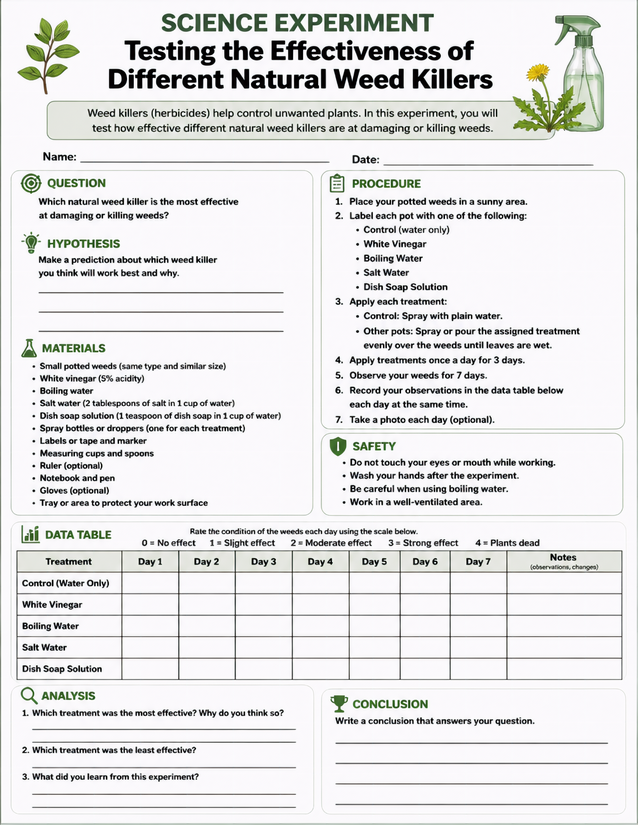
Compare vinegar, boiling water, salt water, and dish soap with this natural weed killers lab sheet for grades 4-7 homeschoolers.
Getting Started with the Natural Weed Killers Lab Sheet

Usage Notes
White vinegar at 5% acidity, table salt, and dish soap are pantry staples. Boiling water requires adult supervision, and the sheet flags this explicitly under its Safety section alongside reminders to avoid touching eyes, wash hands after, and work in a ventilated space. Small potted weeds of the same type keep the test fair, and labels or tape for marking each pot are the only specialty prep needed.

Printing Tips
A 20-lb or 24-lb copy-weight sheet works fine here since students fill in the data table once daily at a desk rather than outdoors. Slip the printed sheet into a plastic page protector inside a lab notebook so accidental water splashes during treatment days do not destroy a week of recorded data.