Creative Minds 𖹭 Happy Hearts

Water Filtration Methods Lab Sheet, Four-Method Comparison
Four cups, four setups, one dirty water sample: the water filtration methods lab sheet gives your student a real reason to care about what actually cleans water.
Dirty water goes in, and four different filtration setups compete to produce the clearest result. The water filtration methods lab sheet walks students through Method 1 (no filter control), Method 2 (coffee filter), Method 3 (sand plus gravel), and Method 4 (sand plus gravel plus activated charcoal plus cotton balls), measuring turbidity in milliliters across all four trials. A data table tracks turbidity, water appearance, color, particles, and other sensory observations like smell. Suited for grades 4 to 6, the sheet includes a hypothesis section, a structured procedure, and three analysis questions that push students to justify which method performed best and why.
As a standalone homeschool worksheet, it fits naturally into an earth science or environmental science unit study covering water treatment, natural resources, or the water cycle. Your student demonstrates scientific comparison skills by running parallel trials under the same conditions and drawing a conclusion supported by their own recorded data. The conclusion prompt asks them to summarize what the experiment revealed, making this a strong writing integration point as well.
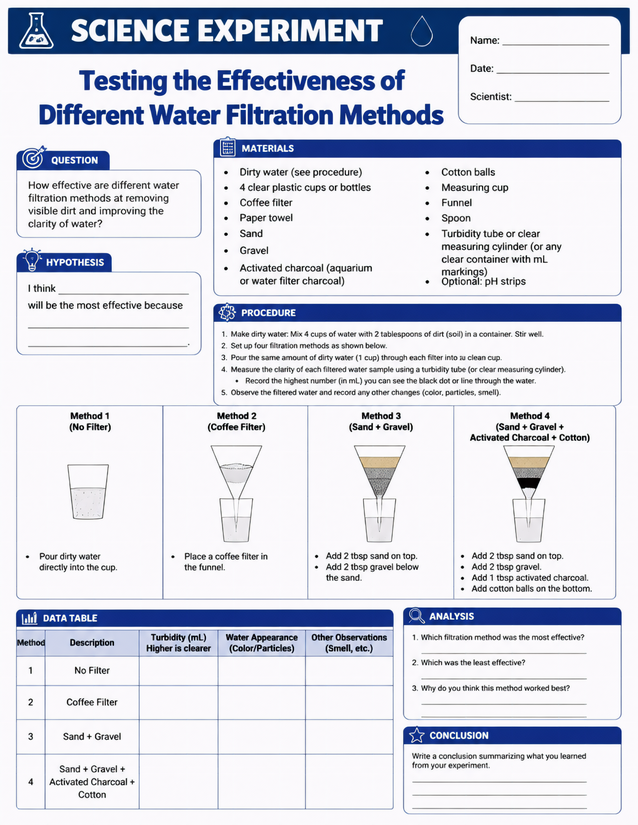
Compare four water filtration methods with this water filtration methods lab sheet, designed for grades 4 to 6 homeschoolers.
Exploring the Water Filtration Methods Lab Sheet at Home

Usage Notes
Nearly every material on this sheet is already in a typical home: a plastic cup or bottle, a paper towel, a coffee filter, sand, and gravel are the core supplies. Activated charcoal is the one specialty item, available as aquarium charcoal from a pet supply store. Students handle dirty soil water, so remind them to wash hands thoroughly after handling filtered samples, and note that filtered water from this experiment is not safe to drink.

Printing Tips
Card stock at 65-lb or heavier holds up when students are measuring, pouring, and writing at the same time without the page wrinkling from damp hands. Loose on a clipboard works well next to the experiment setup, or punch and insert into a dedicated science lab notebook to keep all trial data together.