Creative Minds 𖹭 Happy Hearts

Hand Sanitizer Effectiveness Lab Sheet, Agar Plate Colony Count
Four sanitizers, five agar plates, and three days of colony counting: this hand sanitizer effectiveness lab sheet turns a bathroom staple into a rigorous microbiology experiment your student will actually remember.
Your homeschooler compares three to four hand sanitizers against a no-sanitizer control by swabbing hands onto labeled nutrient agar plates and counting bacterial colonies over three consecutive days. The results table tracks Day 1, Day 2, and Day 3 colony counts plus a three-day average for each plate, giving students a concrete, visual answer to which sanitizer reduces germs most. Designed for grades 5-8, the hand sanitizer effectiveness lab sheet walks students through forming a written hypothesis before testing and guides them through four analysis questions at the end.
This experiment fits naturally into a unit study on microbiology, hygiene science, or consumer product testing and works as a standalone multi-day investigation without needing prior lab experience. A built-in challenge section asks students to formulate a homemade sanitizer recipe and run it against the store-bought options, extending the experiment by several more days if you want to push further. Completing the sheet demonstrates a student’s ability to control variables, track quantitative data across time, and draw evidence-based conclusions.
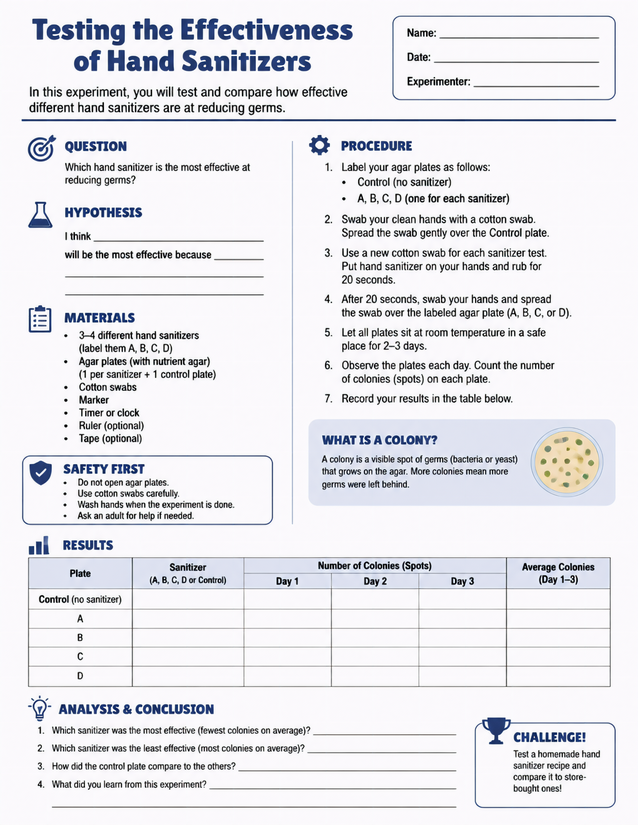
Grades 5-8 homeschoolers compare hand sanitizer effectiveness lab sheet results using agar plates and colony counts over three days.
Setting Up the Hand Sanitizer Effectiveness Lab Sheet at Home

Usage Notes
Nutrient agar plates are the one specialty item here. They are available through science supply retailers and are not a household staple, so order them before your start date. Cotton swabs, a marker, tape, a timer, and a ruler are ordinary household supplies. The safety section on the sheet explicitly instructs students not to open agar plates once inoculated and to ask an adult for help, so plan to supervise the swabbing steps and the plate-reading sessions.

Printing Tips
Use 24-lb paper at minimum so pencil entries in the results table stay legible through three days of handling. Print one sheet per experiment run and keep it loose on a clipboard near wherever the plates are sitting, since students will return to it daily to record colony counts.