Creative Minds 𖹭 Happy Hearts

Flammability of Different Natural Materials Lab Sheet
Flammability of different natural materials turns into a structured, data-driven experiment when your student works through ignition time, burn duration, and flame height side by side.
Your student starts with a written hypothesis, predicting which natural material will burn most readily and explaining why. The results table then guides them through recording whether each sample ignited easily, how long it burned in seconds, and whether the flame height was low, medium, or high. This makes it a strong fit for grades 5-7 homeschoolers studying physical properties, combustion basics, or earth science units.
The flammability of different natural materials experiment works well as a standalone lesson or as part of a broader unit study on chemistry, fire ecology, or material properties. Completing the sheet asks your student to identify patterns across multiple trials and form a data-backed conclusion, which builds both scientific reasoning and written communication skills.
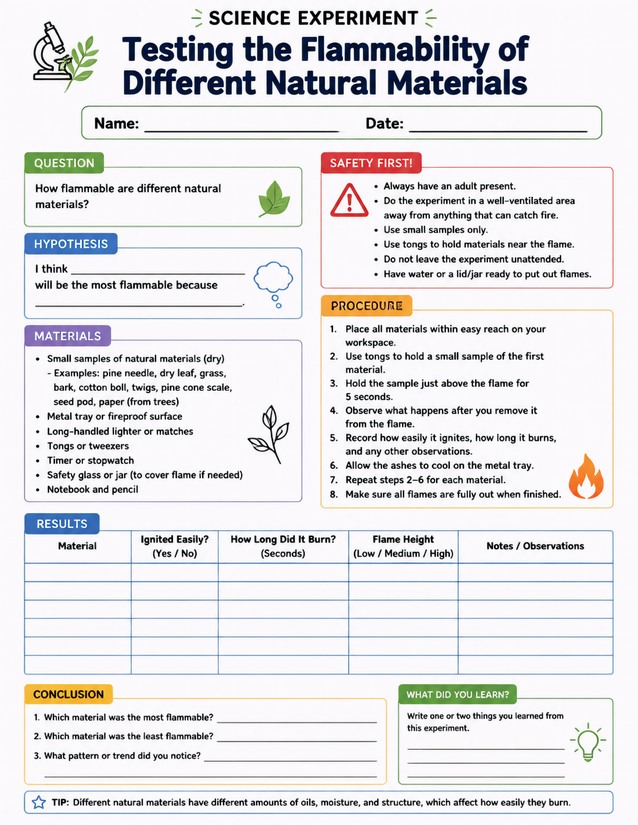
Explore the flammability of different natural materials with this grades 5-7 homeschool science lab sheet. Adult supervision required.
Investigating the Flammability of Different Natural Materials

Usage Notes
Adult supervision is non-negotiable here. The sheet calls for a metal tray or fireproof surface, long-handled tongs or tweezers, a lighter or matches, and a timer. Most of the test samples, including pine needles, dry leaves, grass, bark, twigs, cotton boll, and seed pods, are household or backyard items, but the lighter and the open flame make this a high-supervision experiment regardless of grade level.

Printing Tips
Sixty-pound text weight paper gives the results table enough body to write on with a pen during the experiment without the sheet sliding around. A single loose sheet on a hard clipboard near the workspace keeps it accessible without putting it close to the flame.