Creative Minds 𖹭 Happy Hearts

Force Required to Break Different Types of Wood, Lab Sheet
Wood grain, density, and a spring scale tell a story your student can measure. Recording the force required to break wood across five sample types turns a simple pull into a real materials science investigation.
Structured for grades 5 through 8, this lab sheet walks your student through a controlled comparison of three to five wood samples cut to identical dimensions. The data table captures type of wood, length, width, thickness, and force to break in Newtons, plus a notes column for grain and appearance observations. Analysis questions push beyond the numbers, asking which sample required the most force, which required the least, and how grain or density may have shaped those results.
The force required to break wood experiment fits naturally into a physical science or materials science unit study, and it pairs well with lessons on density, structural engineering, or natural resources. Completing the sheet asks your homeschooler to demonstrate controlled variable setup, Newton-scale measurement, data recording, and evidence-based reasoning, all in a single session.
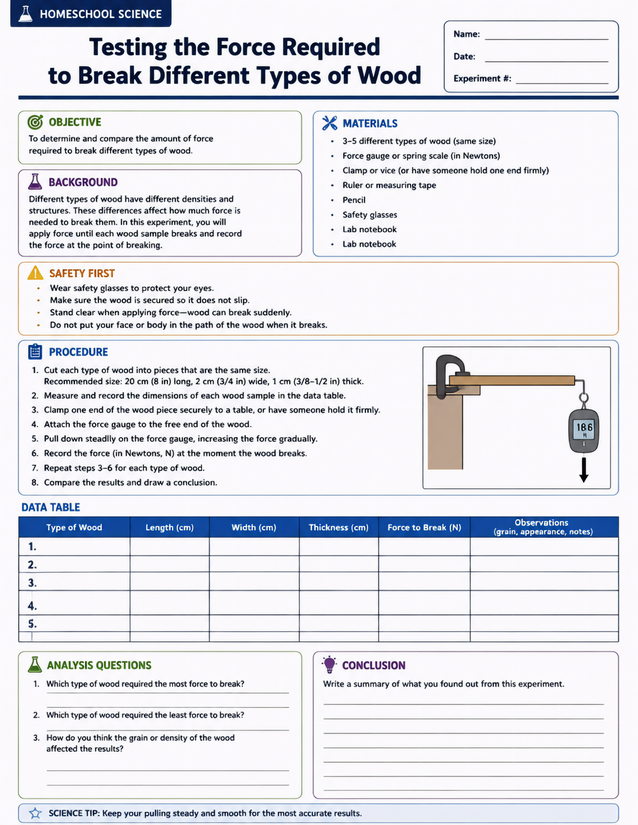
Measure the force required to break wood samples with this hands-on homeschool science lab sheet for grades 5 through 8.
Recording Results for Force Required to Break Wood

Usage Notes
Your student will need three to five wood pieces cut to the same size, a force gauge or spring scale reading in Newtons, and a clamp or vice to secure the wood during pulling. A ruler or measuring tape, pencil, safety glasses, and a lab notebook round out the list. All materials are either household items or available at a hardware store, but the force gauge is the one specialty piece worth tracking down before lab day. The safety section on the sheet flags that wood can snap suddenly, so clear bystanders and never position hands or face in the break path.

Printing Tips
Twenty-four-pound copy paper handles pencil and pen entries cleanly across the five-row data table without bleed-through. Punch and insert into a three-ring lab notebook so the sheet stays beside your unit study notes, or keep it loose on a hard clipboard for hands-on use at the workbench.