Creative Minds 𖹭 Happy Hearts

Insulation Properties of Different Materials Lab Sheet
Seven materials, one hot cup, forty minutes of data. Recording the insulation properties of different materials has never been this straightforward for a home science session.
Students pour identical amounts of hot water into two cups, wrap each in a different material, and record the temperature every ten minutes for forty minutes. The data table on this insulation properties of different materials lab sheet tracks results for bubble wrap, cotton fabric, aluminum foil, felt, cardboard, and newspaper against an unwrapped control, giving grades 4-7 homeschoolers a clear, side-by-side comparison of heat retention across common household items.
This sheet works well as a standalone thermal energy lesson or as part of a broader unit study on states of matter, energy transfer, or everyday materials science. Four analysis questions push your student beyond the numbers to explain why some materials outperform others and how insulators function in daily life, while the conclusion section requires a complete written claim supported by the experimental evidence.
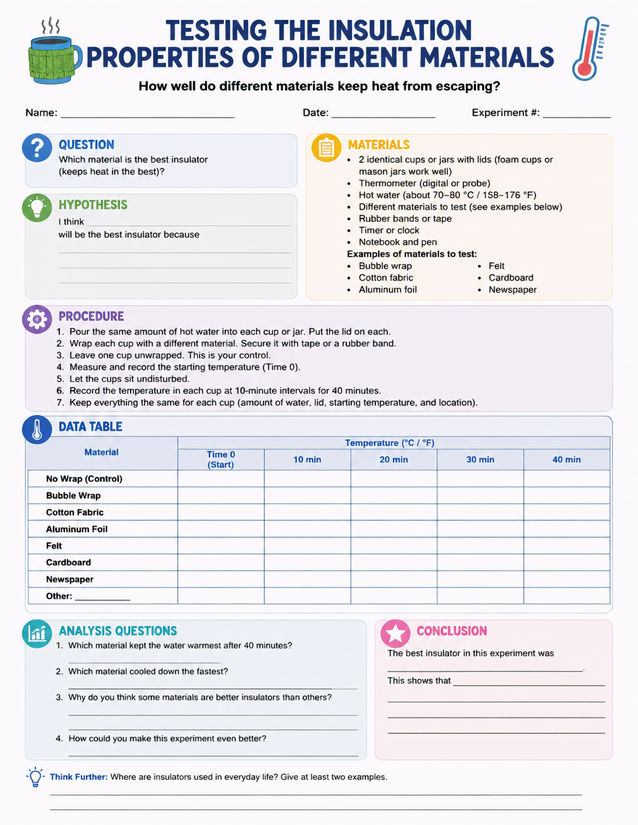
Which wrap keeps hot water warmest? This insulation properties of different materials lab sheet guides grades 4-7 homeschoolers through a 40-minute timed experiment.
Setting Up the Insulation Properties of Different Materials Experiment

Usage Notes
Everything on the materials list is household-level: two identical cups or jars with lids, a thermometer, hot water, rubber bands or tape, and the test materials themselves. No specialty supplies are needed. Hot water is involved, so supervise younger students closely when pouring and handling the cups during temperature readings.

Printing Tips
Twenty-four-pound copy paper handles pencil and pen well during the 40-minute session without buckling. A single loose sheet on a clipboard works cleanly here since students return to the data table multiple times, and the format does not lend itself to laminating given the written conclusion and analysis responses.