Creative Minds 𖹭 Happy Hearts

Load-Bearing Capacity of Egg Shells Lab Sheet
Three eggs, a stack of coins, and one surprising result: the load-bearing capacity of egg shells turns out to be far more impressive than most students expect.
Students test the load-bearing capacity of egg shells by stacking coins one at a time onto a vertically oriented egg held in a cup or ring stand. The sheet guides your homeschooler through recording the number of coins at cracking point for three separate eggs, estimating the weight in grams, noting whether each shell cracked or collapsed, and calculating the average load-bearing result. A built-in hypothesis prompt and a background section explaining how curved geometry distributes force make this a strong fit for grades 4 through 7.
The load-bearing capacity of egg shells experiment works well as a standalone hands-on lesson within a unit study on structural engineering, force, or animal biology. A data table with three trials plus an average row pushes your student to think statistically rather than accepting a single result, and the conclusion prompt asks them to compare their findings against their hypothesis directly. Safety notes at the bottom remind students to wash hands before and after, which is worth reviewing with your homeschooler before the first egg goes on the stand.
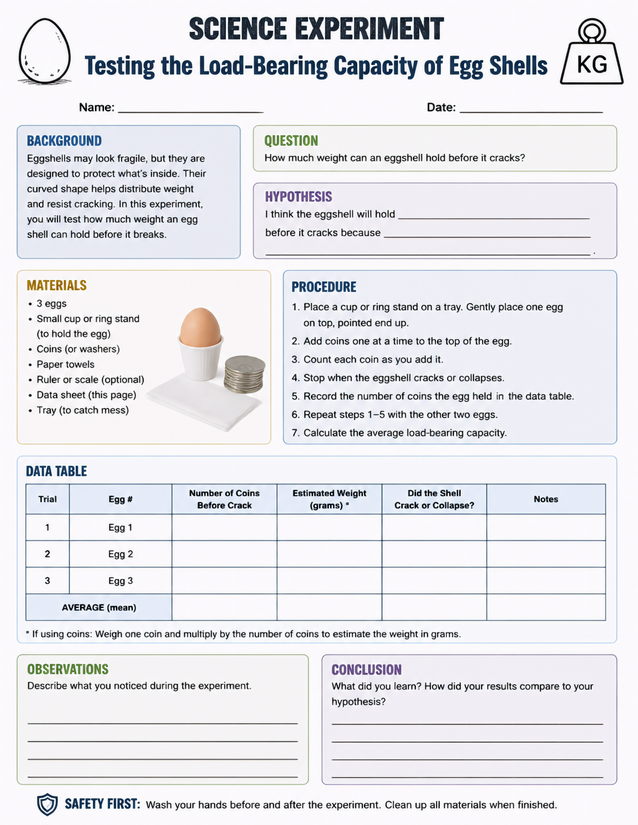
Coins, a ring stand, and three eggs reveal the load-bearing capacity of egg shells in this grades 4-7 homeschool lab sheet.
Investigating the Load-Bearing Capacity of Egg Shells

Usage Notes
Eggs, coins or washers, a small cup or ring stand, paper towels, and a tray are all standard household items. A ruler or scale is listed as optional but helpful if your student wants to estimate gram weight precisely. No open flame or chemicals are involved, though the sheet does flag handwashing before and after as a required safety step.

Printing Tips
Twenty-four-pound copy paper holds up fine for pencil entries during the experiment. Slip the sheet into a plastic page protector if you want to reuse the data table section for a second round of trials without reprinting.