Creative Minds 𖹭 Happy Hearts

Metals Reacting with Different Acids Lab Sheet, Data Table Included
Four metals, three acids, nine test tubes: the metals reacting with different acids lab gives your homeschooler a front-row seat to hydrogen gas production and real reactivity patterns.
This lab sheet guides your student through a structured investigation into how magnesium, zinc, iron, and copper each respond when exposed to dilute hydrochloric, sulfuric, and acetic acid. The data table asks students to record bubble count on a 0-3 scale, rate of reaction as slow, medium, or fast, and any observations like color change or heat for each of the nine metal-acid combinations. Suited for grades 5-8, the metals reacting with different acids lab builds genuine fluency with reactivity series concepts before your student ever opens a textbook chapter on it.
The sheet works as a standalone hands-on learning activity or as the centerpiece of a chemistry unit study on acids, metals, and gas production. A hypothesis section asks students to predict outcomes before they begin, and the think-further prompt at the bottom pushes them to explain why some metal-acid pairs produced no visible reaction at all. Completing the full data table demonstrates that your homeschooler can control variables, observe systematically, and draw evidence-based conclusions.
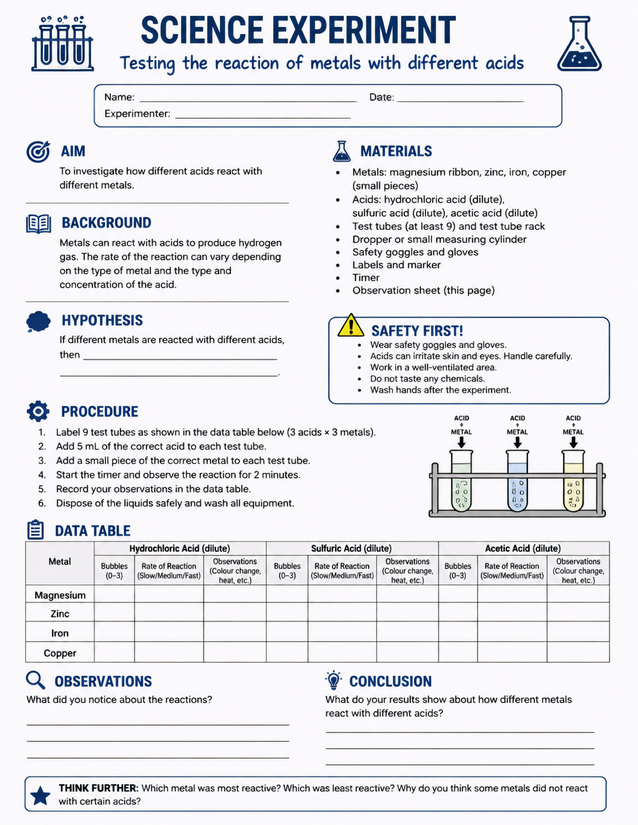
Grades 5-8 homeschoolers test magnesium, zinc, iron, and copper against three dilute acids in this metals reacting with different acids lab. Download instantly.
Getting Results with the Metals Reacting with Different Acids Lab

Usage Notes
Nine test tubes and a rack are the specialty items here. The metals, magnesium ribbon, zinc, iron, and copper pieces, can often be sourced from a home science kit or hobby supplier, while safety goggles, a timer, and labels are standard household or school supplies. The sheet flags a clear safety note: acids irritate skin and eyes, so gloves and goggles are required and the work area must be well-ventilated.

Printing Tips
A 32-lb paper or card stock holds up better than copy weight when students are writing quickly across nine data cells during a timed two-minute observation window. Slide the loose sheet into a clipboard for easy access during the experiment, then transfer it to a lab notebook once dry.