Creative Minds 𖹭 Happy Hearts

Testing the Tensile Strength of Different Types of Tape
Pull until it breaks. The tensile strength of different types of tape turns out to be surprisingly measurable with a spring scale and a stack of books.
Students in grades 5-7 test whether masking tape, scotch tape, duct tape, or any other variety holds up differently under pulling force. The sheet walks your homeschooler through cutting a 20 cm strip, folding it into a loop with a 2.5 cm overlap, anchoring it between two books, and attaching a spring scale to pull downward until the tape breaks. Three trials per tape type feed into an average tensile strength column, keeping the data honest and the results comparable.
This lab fits naturally into a unit study on materials science, forces, or measurement. It stands alone as a one-session experiment, but it also pairs well with lessons on friction, adhesion, or engineering design. By the end, your student has practiced controlled variable testing, reading a spring scale in newtons, and drawing conclusions from averaged data, all skills that build directly on each other in future lab work involving the tensile strength of different types of tape.
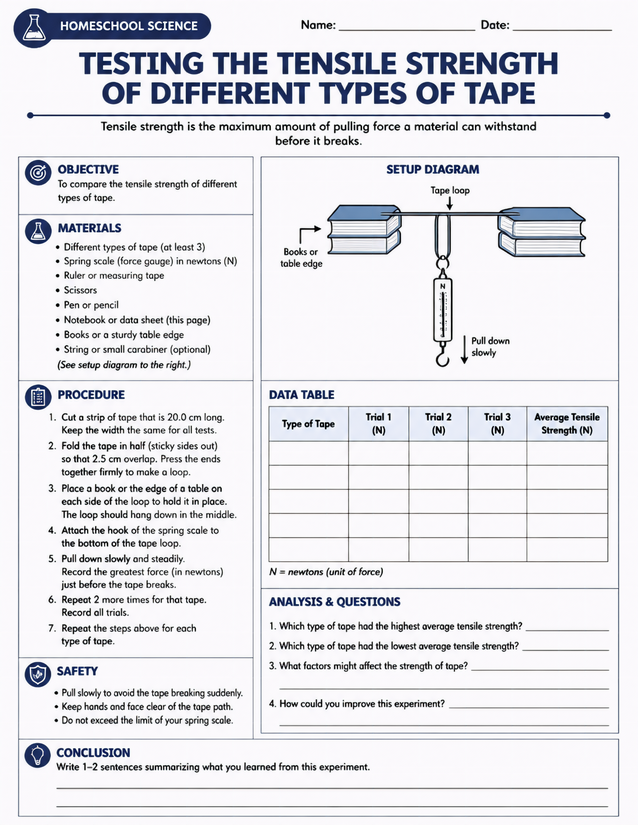
Measure the tensile strength of different types of tape using a spring scale in this hands-on homeschool science lab for grades 5-7.
Investigating the Tensile Strength of Different Types of Tape

Usage Notes
At least three types of tape are required, along with a spring scale that reads in newtons, a ruler, scissors, and books or a sturdy table edge. The tape and books are household staples, but a spring scale or force gauge is a specialty supply your homeschool science kit should have on hand. Safety notes on the sheet remind students to pull slowly and keep hands and face away from the tape path to avoid a sudden snap.

Printing Tips
Cardstock at 65 lb weight gives the data table enough surface to handle repeated pencil entries and erasing without the paper warping. Slip it loose on a clipboard so your student can reposition it easily while managing the spring scale during the experiment.