Creative Minds 𖹭 Happy Hearts

Testing the Transparency of Different Types of Plastic
Plastic bags, lids, wrap, folders: your student rates the transparency of different types of plastic using a simple printed-text test and a four-point scale.
Your homeschooler places printed text under each plastic sample, tapes it flat, looks through, and rates readability on a scale from one to four. The sheet walks through the full scientific method: a guiding question, a hypothesis with sentence starters, a six-step procedure, a data table with columns for type of plastic, description, transparency rating, and notes, and a structured conclusion section that asks which plastic was most and least transparent and why differences occurred. This lab suits grades 4 to 6 and works well as a standalone homeschool worksheet or as part of a materials science unit study.
The transparency of different types of plastic is a concept your student can explore entirely with household materials, which makes this a strong choice for a low-prep lab day. Completing the sheet demonstrates your student’s ability to form a testable hypothesis, apply a consistent rating scale, organize observational data, and draw evidence-based conclusions. It pairs naturally with lessons on light, refraction, or polymer chemistry depending on where your homeschooler is in their science sequence.
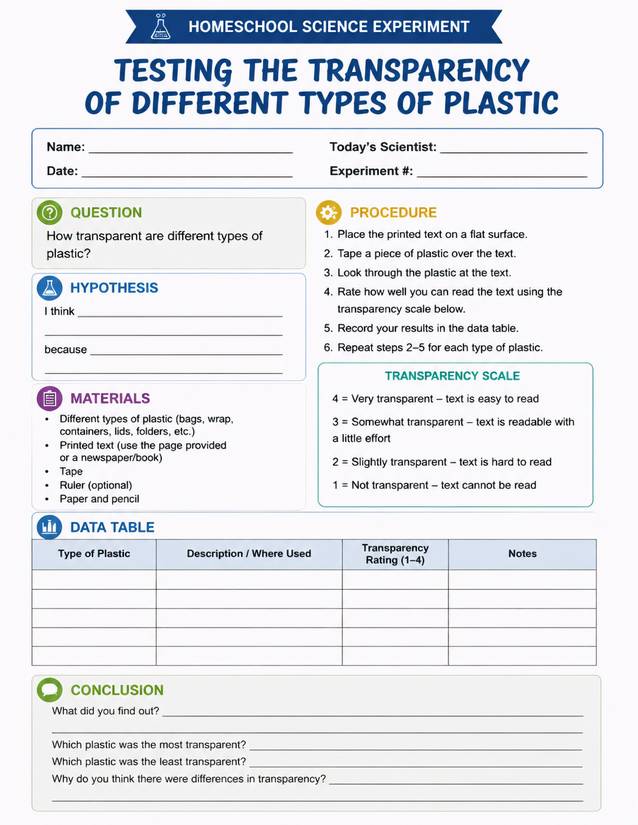
Homeschool grades 4-6 will love rating the transparency of different types of plastic using this structured lab sheet. Download free today.
Investigating the Transparency of Different Types of Plastic

Usage Notes
Every material on the list is a household item: plastic bags, wrap, containers, lids, or folders are the test samples, and students also need tape, printed text or a newspaper page, and paper and pencil. No specialty supplies are required. A ruler is listed as optional, so this lab is genuinely zero-cost to set up.
Printing Tips
Cardstock is unnecessary here since students write ratings during a calm observation process rather than a wet or outdoor experiment. Standard copy paper holds up fine, and the sheet slots neatly into a three-ring lab notebook or science binder for your homeschool records.