Creative Minds 𖹭 Happy Hearts

Water Types Affect Crystal Formation Lab Sheet, Epsom Salt
Seven days, four jars, five water types, one question worth answering. This water types affect crystal formation lab turns a simple Epsom salt setup into a genuinely surprising week-long investigation.
Students compare tap water, distilled water, filtered water, bottled spring water, and boiled and cooled tap water to see which produces the largest and highest-quality Epsom salt crystals over a seven-day observation period. The sheet walks your homeschooler through writing a hypothesis, identifying controlled variables, following a six-step procedure, and recording daily observations in a structured results table that tracks crystal size and quality. Suited for grades 4-7, this water types affect crystal formation experiment builds real scientific literacy around variables, solution saturation, and patient data collection.
Fit this into a chemistry or earth science unit study focused on minerals, crystallography, or states of matter, and it works equally well as a standalone two-week project. Your student demonstrates understanding of controlled experiments by keeping jar size, salt amount, string length, and temperature consistent across all four test jars, then draws evidence-based conclusions from their own recorded data. The conclusion section asks which water produced the largest crystals, which produced the smallest or none, and what the student would change in a second run.
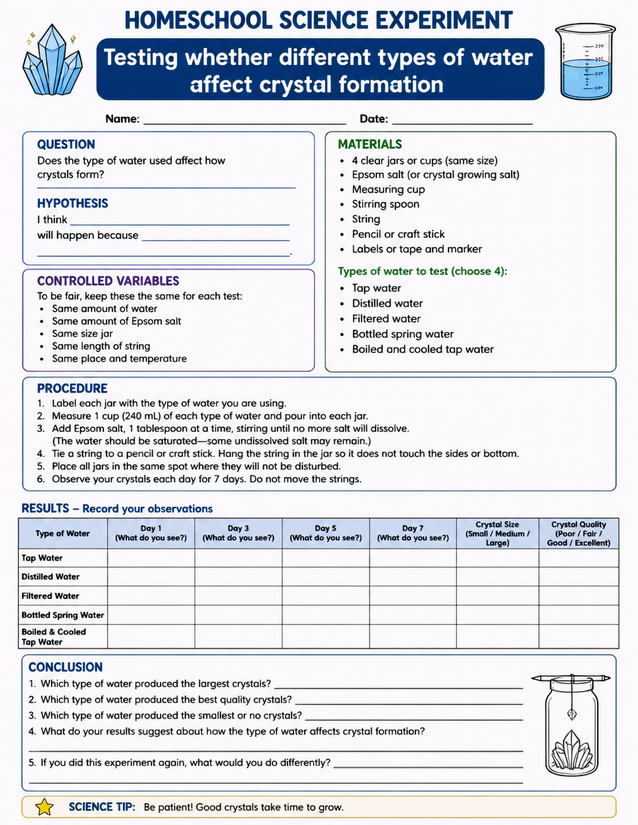
Does tap water grow better crystals than distilled? This water types affect crystal formation lab guides grades 4-7 through a seven-day Epsom salt experiment.
Investigating Water Types Affect Crystal Formation Over Seven Days

Usage Notes
Nearly everything on the materials list is already in most homes: clear jars or cups, a measuring cup, a stirring spoon, string, and a pencil or craft stick. Epsom salt is the one specialty item, though it is inexpensive and widely available at grocery and drug stores. The procedure notes that solutions will reach saturation and some undissolved salt may remain, so students should be reminded not to disturb the jars once strings are in place.
Printing Tips
Eighty-pound text weight paper handles a week of daily pencil entries without the sheet going limp on a clipboard. Slide it into a plastic page protector inside a lab notebook so it stays flat and clean through the full seven-day observation window.