Creative Minds 𖹭 Happy Hearts

Eggshell Color Heat Absorption Lab Sheet, White Brown and Other Eggs
Sunny windowsill, three eggs, three thermometers: the eggshell color heat absorption lab turns a question your student already has into a 30-minute recorded experiment.
Does shell color change how hot an egg gets in direct sunlight? This lab sheet walks your student through the full scientific process for grades 4 to 6, from writing a hypothesis to recording temperatures every five minutes across three egg colors: white, brown, and one wildcard your family chooses. The data table captures readings from 0 to 30 minutes, and four analysis questions push students to compare results rather than just copy numbers down.
The eggshell color heat absorption lab fits naturally into a unit study on heat transfer, light energy, or the electromagnetic spectrum. It works as a standalone afternoon experiment or as a second lab paired with a lesson on surface color and radiation absorption. Completing it demonstrates a student’s ability to control variables, collect time-series data, and draw a conclusion supported by numerical evidence.
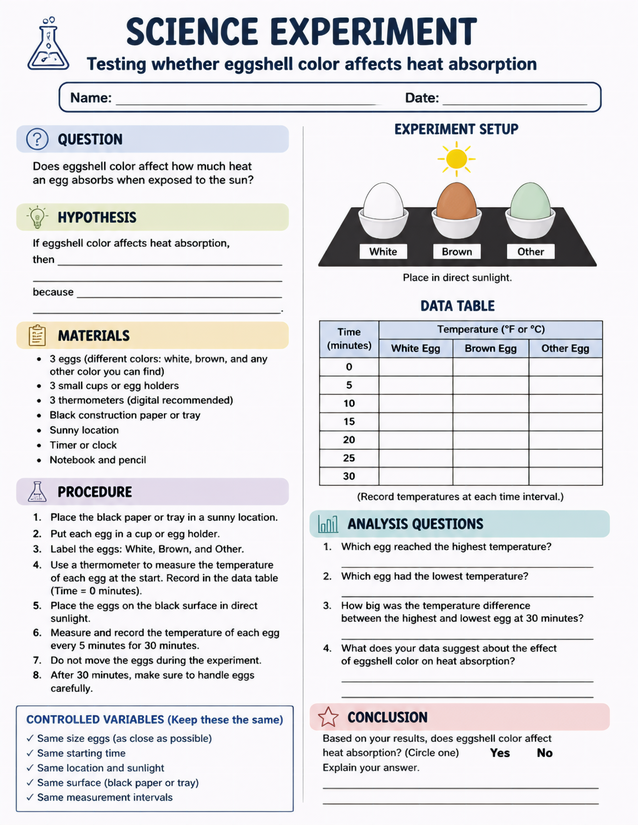
Grades 4-6 homeschool science: the eggshell color heat absorption lab records temperature data across white, brown, and other eggs. Instant download.
Setting Up the Eggshell Color Heat Absorption Lab

Usage Notes
Nearly everything on the materials list is already in your kitchen or junk drawer: three eggs of different shell colors, three small cups or egg holders, a timer, and a notebook. The one specialty item is a digital thermometer, and the sheet recommends three of them so all eggs are measured simultaneously. Black construction paper or a dark tray is listed as the test surface, which is a common household craft supply but worth confirming before experiment day.

Printing Tips
Sixty-pound or heavier paper keeps the data table legible when students press firmly while writing temperatures in the field. A loose sheet on a clipboard works well here since students will be moving between the sunny location and their recording spot every five minutes. Laminating only the procedure side and leaving the data table as a fresh print each use is a practical option if you run this experiment with multiple students.