Creative Minds 𖹭 Happy Hearts

Testing Which Fabrics Dry Fastest, Cotton to Fleece
Six fabric swatches, a bowl of water, and a timer are all your student needs for testing which fabrics dry fastest, a hands-on experiment with genuinely useful real-world results.
Testing which fabrics dry fastest asks your student to wet small swatches of cotton, polyester, nylon, denim, fleece, and silk, then record drying times at ten-minute intervals up to sixty minutes. The results table tracks each fabric across six check-in columns, and the analysis section pushes students to identify patterns and explain why some materials shed moisture faster than others. This lab is well-suited for grades 4-6 and connects naturally to physical science units on materials and properties.
The sheet works as a standalone afternoon experiment or as part of a broader unit study on textiles, weather, or everyday chemistry. A “Think Like a Scientist” note at the bottom reinforces fair-test design, reminding your homeschooler to change only one variable, the fabric, while keeping placement, airflow, and timing consistent. Completing the lab demonstrates your student’s ability to control variables, collect timed data, and draw evidence-based conclusions.
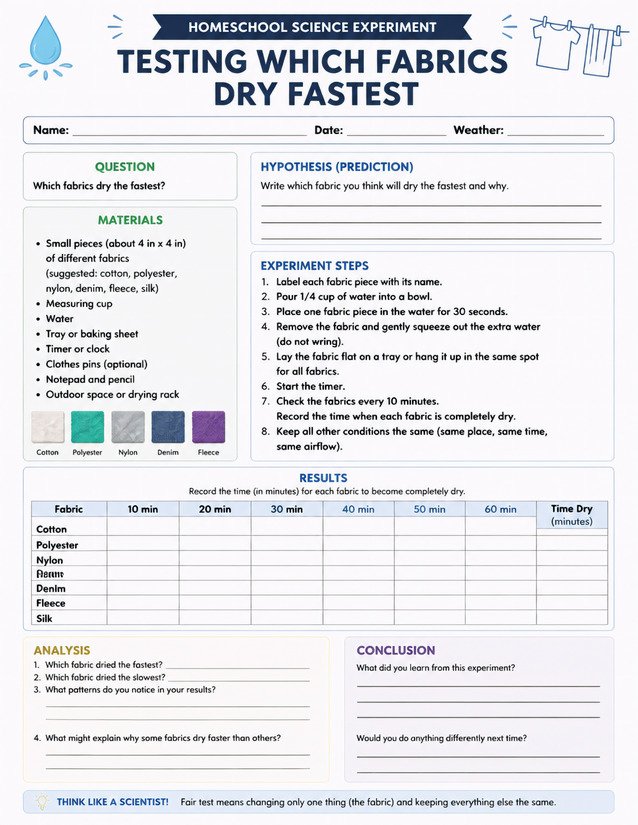
Six fabrics, one timer: testing which fabrics dry fastest gives grades 4-6 homeschoolers real data on material properties. Download free.
Recording Results for Testing Which Fabrics Dry Fastest

Usage Notes
Everything on the materials list is household-level accessible: fabric scraps, a measuring cup, water, a tray or baking sheet, and a timer. Clothes pins and a drying rack are listed as optional, useful if your student chooses to hang the swatches rather than lay them flat. No safety concerns are flagged for this experiment, making it manageable for independent student work with light supervision.

Printing Tips
Standard 20-lb copy paper works fine for this sheet since students are writing with a pencil, not handling wet materials directly. Slip it into a clipboard for easy use outdoors or near a drying rack, and print a second copy if your student wants to repeat the experiment with different fabrics.