Creative Minds 𖹭 Happy Hearts

Testing Which Materials Are Best for Reducing Noise Pollution
Foam sheet or heavy curtain, which one actually stops sound? This lab puts materials best for reducing noise pollution to a measurable, decibel-by-decibel test.
Your student places a Bluetooth speaker inside an open cardboard box, then covers it with one material at a time while recording noise levels in decibels using a smartphone app. The sheet walks through an 8-step procedure, a baseline measurement with no material, and a ranked results table comparing foam sheet, felt, cotton batting, thick towel, carpet sample, corrugated cardboard, bubble wrap, cork board, and heavy curtain. At grades 4-7, this is a strong fit for a physical science or environmental science unit.
Beyond the data table, the analysis section asks your homeschooler to identify which material reduced the most noise, which reduced the least, and why certain materials outperformed others, pushing toward explanatory thinking rather than just observation. The materials best for reducing noise pollution experiment works as a standalone lab or as a natural companion to a unit on sound waves, environmental science, or sustainable design. Completing it demonstrates controlled variable testing, quantitative data recording, and evidence-based reasoning.
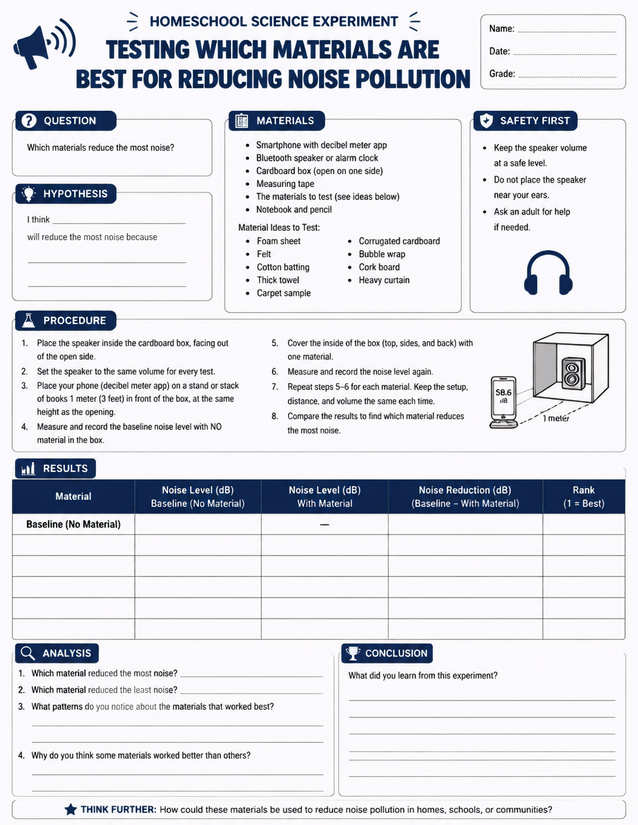
Measure decibels, rank insulating materials, and record real results. This materials best for reducing noise pollution lab suits grades 4-7.
Recording Results for Materials Best for Reducing Noise Pollution

Usage Notes
Most materials on the list are genuinely household items: a thick towel, cardboard box, felt scraps, and a carpet sample are likely already on hand. The one specialty item is a decibel meter app, which is free to download on most smartphones. The safety section on the sheet specifically notes to keep speaker volume at a safe level and never place the speaker near your student’s ears, so review those notes before the first test run.

Printing Tips
Print on 24 lb paper at minimum so the decibel readings your student writes during each test run don’t bleed through. A loose sheet on a clipboard works well here since students move between the speaker setup and the recording table repeatedly. Skip laminating on this one, as the results table and analysis questions require written responses that change with each trial.