Creative Minds 𖹭 Happy Hearts

Natural Materials Make the Best Insulation Homeschool Lab
Four jars, four insulators, one question worth 30 minutes of real data. This natural materials make the best insulation experiment has your student recording temperature drops every five minutes to find out which wrapping actually works.
Your student wraps identical jars with dry leaves, straw, pine needles, wool, or another natural material from the list, pours in hot water, and records temperature readings every five minutes across a 30-minute window. The data table holds six time intervals plus a control jar with no insulation, so the comparison is built right into the sheet. Designed for grades 4-6, this lab sheet pairs hypothesis writing with quantitative data collection in a format homeschoolers can complete in a single afternoon.
The natural materials make the best insulation experiment works well as a standalone unit study on heat transfer or tucked into a broader physical science sequence on thermal energy. A student who completes it can explain why one material outperformed the others using the temperature drop numbers they gathered, not just a guess. The closing reflection prompts ask how animals and plants use insulation in nature, which opens the door to follow-up discussion or further reading.
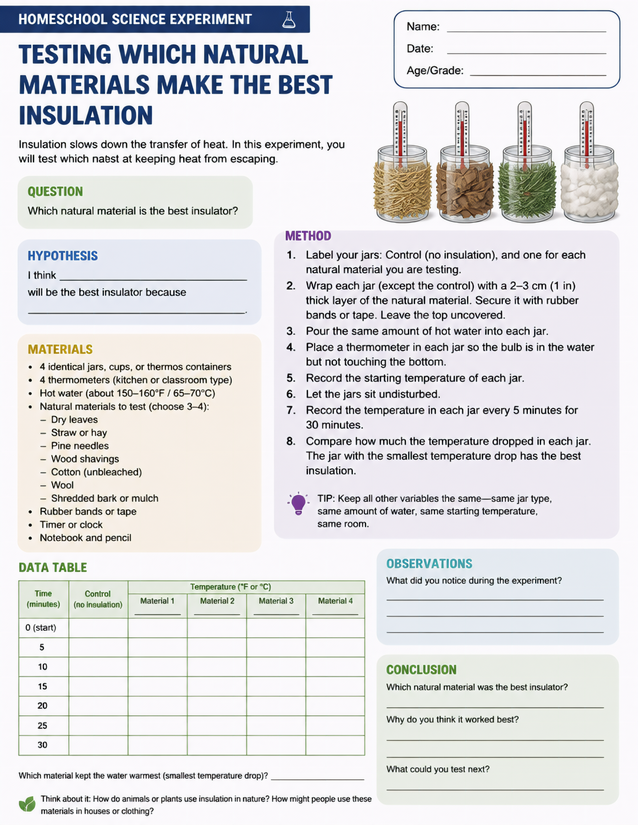
Which natural material keeps heat longest? Test natural materials make the best insulation with this grades 4-6 homeschool experiment sheet.
Exploring Natural Materials Make the Best Insulation at Home

Usage Notes
Hot water at 150 to 160 degrees Fahrenheit is the main safety consideration here, so supervise carefully when filling the jars. The natural materials on the list, including dry leaves, straw, pine needles, wool, and cotton, are household or backyard finds for most families. You will also need four identical jars or cups, four thermometers, rubber bands or tape, and a timer.
Printing Tips
Card stock at 65 lb holds up well if a jar sweats or the workspace gets damp during the hot-water step. Slip the sheet into a clipboard so your student can write comfortably every five minutes without moving the jars.