Creative Minds 𖹭 Happy Hearts

Building a Bridge with Spaghetti and Marshmallows Lab Sheet
Grab the pasta and the marshmallow bag because building a bridge with spaghetti and marshmallows is about to become your student’s favorite engineering afternoon.
Building a bridge with spaghetti and marshmallows is the kind of hands-on experiment that makes structural engineering click for grades 3 through 6. The sheet guides your student through a full scientific process: writing a hypothesis, following a six-step procedure, and recording bridge status against a running weight count using coins or small objects as load. A tips panel highlights triangle-based truss design, and a labeled example truss diagram gives students a visual reference before they build.
This lab fits naturally into a physical science or engineering unit study and works well as a standalone afternoon experiment. By the time your homeschooler fills in the observations and conclusion sections, they have demonstrated load-bearing principles, basic structural reasoning, and the ability to reflect on what they would change in a second attempt. An extension challenge at the bottom pushes students who finish early to redesign and retest.
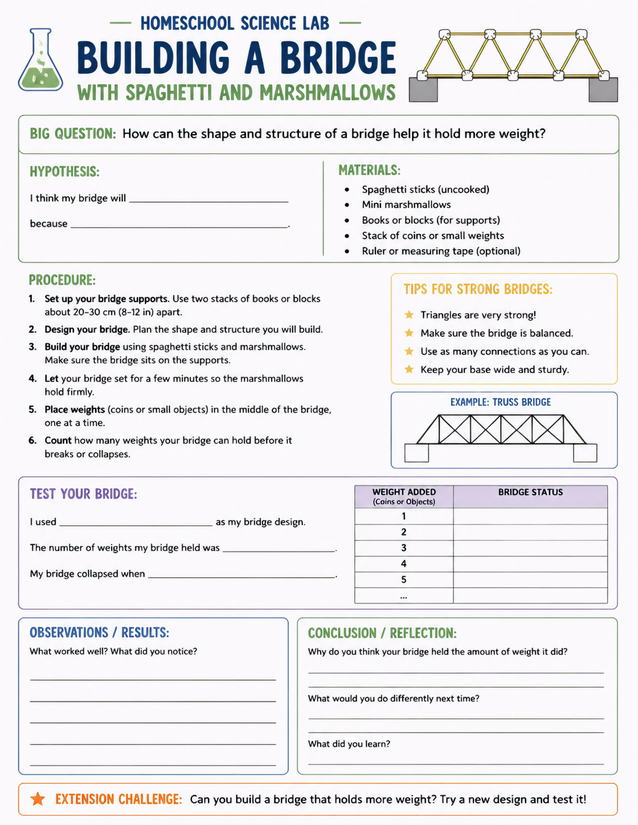
Hands-on building a bridge with spaghetti and marshmallows lab sheet for grades 3-6 homeschoolers. All household materials included.
Getting Started with Building a Bridge with Spaghetti and Marshmallows

Usage Notes
Every material on this sheet is a household staple: uncooked spaghetti sticks, mini marshmallows, books or blocks for supports, and a stack of coins for weights. A ruler or measuring tape is listed as optional for spacing the supports 20 to 30 cm apart. No specialty supplies are needed, and the only safety note implied is supervising younger students around uncooked pasta ends.
Printing Tips
A standard 20 lb copy paper works fine, but 24 lb paper holds up better if your student rests a hand on the sheet while recording weights mid-experiment. Punch and insert into a lab notebook after the build, or keep it loose on a clipboard right next to the bridge for easy access during the weight-counting step.