Creative Minds 𖹭 Happy Hearts

Faraday Cage Lab Sheet, Cell Phone Signal Blocking Experiment
Aluminum foil, a cardboard box, and a cell phone are all it takes to make electromagnetic shielding real. This faraday cage lab sheet walks your student through building and testing the whole thing.
Students in grades 6 to 8 build a foil-lined cardboard enclosure, place a cell phone inside, and use a second phone to attempt calls, texts, and Wi-Fi connections while the lid is closed. The faraday cage lab sheet captures results in a three-column observations table, comparing what happens inside versus outside the cage for each signal type, then closes with reflection questions that ask students to explain the science behind what they observed and name real-world applications.
This experiment fits naturally into an electromagnetism or physics unit study and works as a standalone hands-on lesson when you need something concrete to anchor abstract concepts like electromagnetic shielding. Completing the sheet demonstrates that a student can design a controlled test, record comparative data, and draw a conclusion grounded in evidence, skills that build directly toward more formal lab report writing.
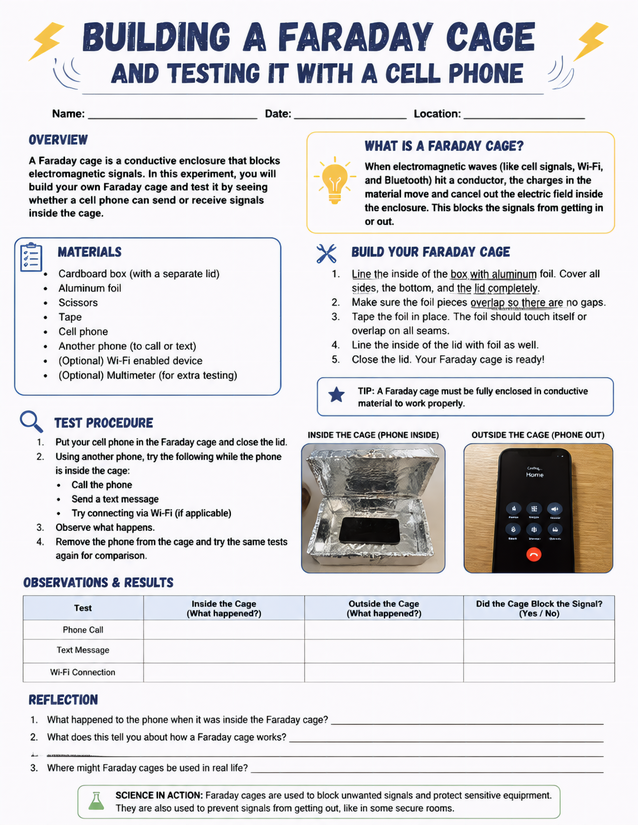
Record cell phone signal results with this faraday cage lab sheet, suited for grades 6-8 homeschool science units on electromagnetism.
Investigating with Your Faraday Cage Lab Sheet

Usage Notes
All core materials are household items: a cardboard box with a separate lid, aluminum foil, scissors, tape, and two phones. The sheet notes optional extras including a Wi-Fi enabled device and a multimeter for extended testing. No chemicals or heat sources are involved, so safety setup is minimal, though students should handle scissors carefully during the foil-cutting steps.

Printing Tips
Standard copy paper works fine for writing during the experiment, but 24 lb paper holds up better if the sheet rests on a clipboard next to a foil-covered work surface. Slide it into a plastic page protector to keep it clean, or punch and bind it directly into your student’s science lab notebook when the session is done.