Creative Minds 𖹭 Happy Hearts

Wind Farm Model Lab Sheet, Measure Voltage and Power Output
Clip leads, spinning blades, and a multimeter reading in real time: the wind farm model lab sheet turns renewable energy from a textbook topic into something your student can actually measure.
Students build a working model wind farm using small DC motors as generators, plastic or cardboard blades, and a fan as the wind source, then use a digital multimeter to record voltage and current across multiple test runs. The data table on the wind farm model lab sheet captures fan speed setting, number of turbines, volts, amps, and calculated watts, giving grades 5 to 8 homeschoolers a genuine introduction to electrical measurement and the power formula P equals V times I.
Five analysis questions push the experiment beyond data collection, asking your student to explain how turbine count and fan speed affected output and to consider real-world wind farm design challenges. Whether this sits inside a renewable energy unit study or as a standalone applied-physics lab, completing it demonstrates that your homeschooler can design a controlled test, manipulate a single variable, and draw evidence-based conclusions from quantitative data.
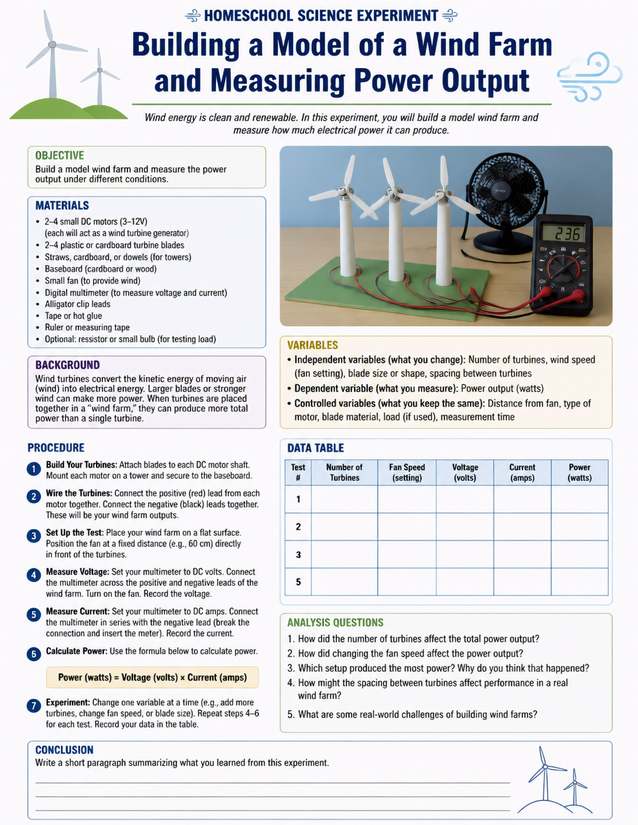
Record voltage, current, and power output with this wind farm model lab sheet, designed for homeschool science in grades 5 to 8.
Investigating Your Wind Farm Model Lab Sheet

Usage Notes
DC motors rated 3 to 12 volts are the specialty item here, but they are inexpensive and widely available online. Everything else, including straws, cardboard, tape, alligator clip leads, and a small box fan, is likely already in a well-stocked homeschool supply closet. Alligator clips connect directly to multimeter probes, so no soldering is involved, though the sheet implies adult supervision when the series circuit for current measurement is broken and reconnected.

Printing Tips
Standard 20 lb printer paper works fine for the data table, but 24 lb gives a sturdier surface when the sheet sits on a clipboard next to a running fan. Hole-punch the completed sheet and file it directly into a science lab notebook so the data table stays paired with your student’s conclusion paragraph.