Creative Minds 𖹭 Happy Hearts

Layers of the Earth Model Lab Sheet, Homeschool Earth Science
Cut open a clay Earth and suddenly those four layers stop being vocabulary words. This layers of the earth model lab sheet walks your student through building, slicing, and recording every layer from crust to inner core.
The layers of the earth model lab sheet guides students through an eight-step hands-on build using colored clay or play dough to represent the crust, mantle, outer core, and inner core. After cutting away a section to expose the layers, students fill in an observations table recording the color used, relative thickness, and role of each layer, then answer three discussion questions about heat and thickness. The sheet is written for grades 4 to 6 and fits squarely within an Earth Science unit.
As a standalone activity this lab sheet works well as the anchor lesson for a layers of the earth unit study, giving your homeschooler a concrete reference model they can keep. Students who complete it demonstrate understanding of Earth’s interior structure, relative layer thickness, and the difference between the outer and inner core. The Extend Your Learning section points toward follow-up research on layer temperatures and a poster or slide presentation, so the sheet can stretch across two or three sessions if your curriculum calls for it.
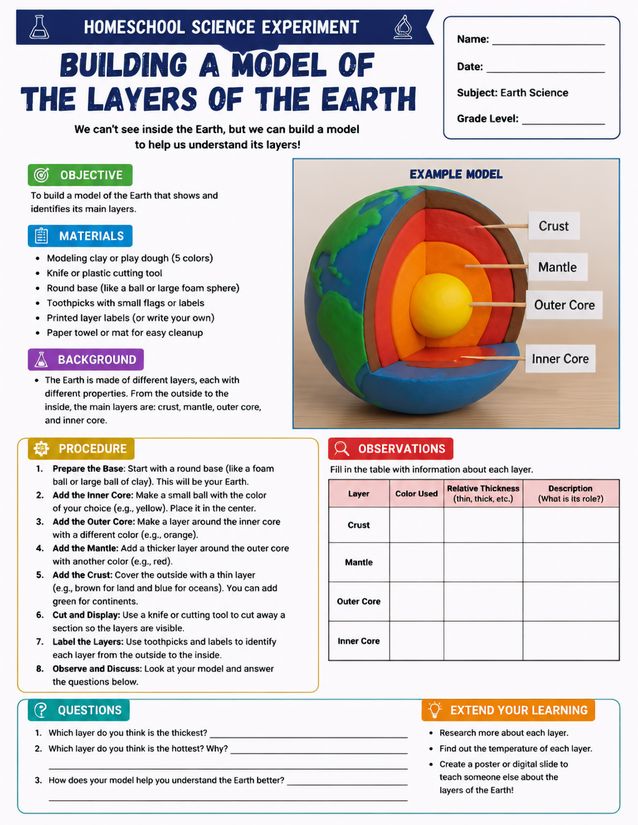
Your homeschooler builds and labels a cross-section Earth model using this layers of the earth model lab sheet, suited for grades 4 to 6.
Exploring the Layers of the Earth Model Lab Sheet

Usage Notes
Modeling clay or play dough in five colors is the main supply, along with a round base such as a foam ball, toothpicks with small flag labels, and a knife or plastic cutting tool for slicing the model open. Most of these are household or craft-drawer items, though a foam sphere may require a quick store run. The cutting step means supervising younger students closely, and the sheet implicitly calls for a paper towel or mat underneath to protect your work surface.

Printing Tips
Twenty-four pound paper or heavier is worth it here because students press down while filling in the observations table. A loose sheet on a clipboard next to the build surface keeps it flat and clay-free. Laminating is not ideal since students write in the table and questions sections.