Creative Minds 𖹭 Happy Hearts

Building a Model of the Nervous System, CNS and PNS Lab Sheet
Pipe cleaners radiating from a styrofoam ball make the nervous system click in a way no diagram ever does. Building a model of the nervous system gives your student something they can label, hold, and explain.
Building a model of the nervous system walks students in grades 4 to 6 through constructing a three-dimensional representation of the CNS and PNS using a styrofoam ball for the brain, pipe cleaners for the spinal cord, and additional pipe cleaners or string spread outward as nerves. The sheet includes a background section covering how the nervous system receives, processes, and sends information, a materials checklist, and five numbered procedure steps. The observations section asks students to describe in writing what each part of their model represents, and the analysis prompt asks how the model shows the nervous system working as a communication network.
This lab fits naturally into a body systems unit study and works well as a standalone hands-on session before or after reading-based lessons on the brain and spinal cord. An extension challenge on the sheet asks students to add sensory input and response examples using arrows or notes, pushing into higher-order thinking. Completing building a model of the nervous system demonstrates that your homeschooler can distinguish the CNS from the PNS, physically represent nerve pathways, and articulate how the parts function together.
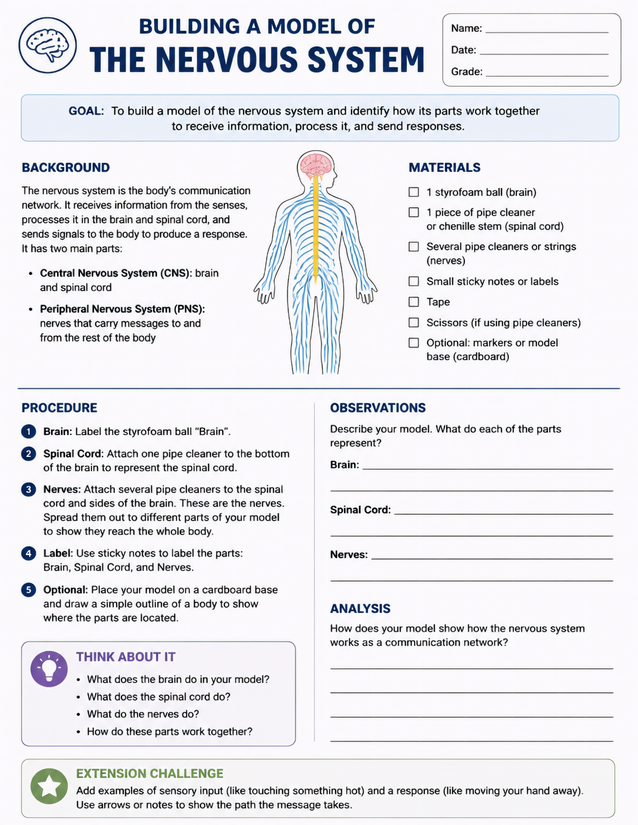
Hands-on and labeled, building a model of the nervous system guides grades 4 to 6 through CNS and PNS structure with everyday craft supplies.
Investigating Building a Model of the Nervous System at Home

Usage Notes
Supplies on this sheet skew toward craft bin staples. The styrofoam ball, pipe cleaners or chenille stems, sticky notes, tape, and scissors are all household or easily sourced items, though the optional cardboard base and markers add no real difficulty. Scissors are the one safety note worth a quick reminder for younger students cutting pipe cleaners to length.
Printing Tips
Ninety-pound cardstock gives the observations and analysis lines enough body to write on without the sheet bowing when held during construction. A loose sheet on a clipboard next to the build station is easier to reference than one tucked inside a lab notebook mid-project, though it can be bound in afterward once the model is complete.