Creative Minds 𖹭 Happy Hearts

Rube Goldberg Machine Lab Sheet, Design to Test
Cause and effect has never looked this chaotic on paper. Your student gets a full rube goldberg machine lab sheet that takes them from setting the end goal all the way through three test attempts.
Structured around the full engineering design cycle, this rube goldberg machine lab sheet walks students through goal-setting, materials selection, step planning, sketching, and three rounds of testing. The materials checklist includes cardboard, rubber bands, dominoes, marbles, pulleys, and more, and students check off what they plan to use before they build. A labeled sketch box asks them to draw direction-of-motion arrows, which directly supports spatial reasoning at the grades 4 to 8 level where cause-and-effect chains appear in most physical science standards.
The Test and Observe table is where the real learning lands. Three rows record whether each attempt succeeded, what happened, and what the student would change, giving your homeschooler a structured iteration loop rather than a free-for-all build session. Paired with a unit study on simple machines, energy transfer, or Newton’s laws, the rube goldberg machine lab sheet holds the documentation side of a project that could span several days. The Reflect section closes with three written prompts on challenge, learning, and improvement, making it easy to assess both process and understanding.
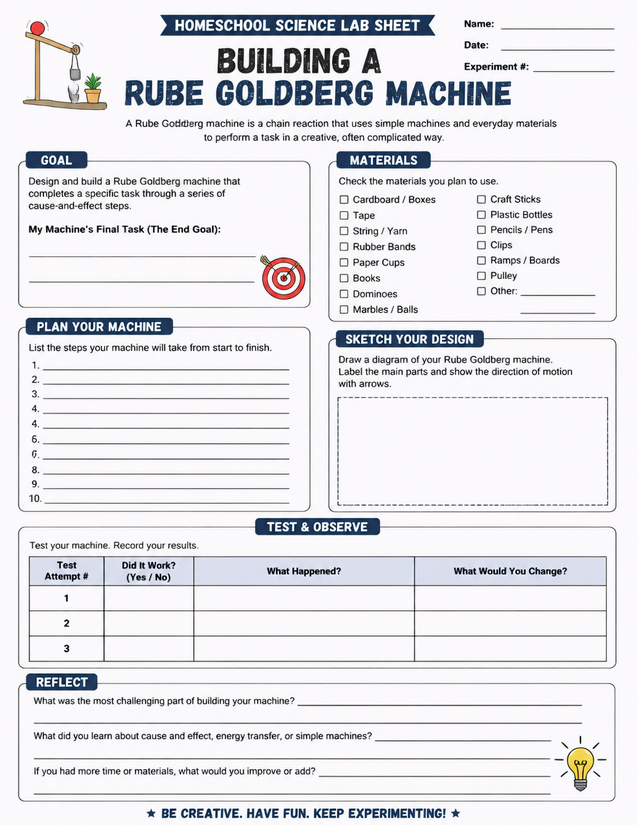
Plan, sketch, and test with this rube goldberg machine lab sheet for grades 4 to 8. Household materials, instant download.
Recording Results for Your Rube Goldberg Machine Lab Sheet

Usage Notes
Cardboard, tape, string, rubber bands, dominoes, marbles, craft sticks, plastic bottles, clips, ramps, and pulleys are all on the checklist. Most are household items your family already has on hand, though pulleys and ramps may need to be sourced or improvised. No safety warning appears on the sheet, but a falling-object reminder is worth adding verbally before build day.

Printing Tips
Heavier paper, around 32-pound or 40-pound, holds up better when the sheet sits near a messy build table. Loose on a clipboard works well during the test phase so your student can write quickly between attempts. Laminating the sketch box only is an option if you want students to redraw plans without printing a new sheet each iteration.