Creative Minds 𖹭 Happy Hearts

Building a Simple Catapult and Measuring Projectile Distance
Seven craft sticks, two rubber bands, and a plastic spoon are all it takes. This building a simple catapult lab sheet walks your student through construction, data collection, and analysis in one tidy session.
Your student builds a working catapult from craft sticks, rubber bands, a plastic spoon, and a bottle cap, then launches small projectiles like pom-poms or marshmallows and measures how far each one travels. The sheet guides them through six recorded trials, logging the projectile type and distance in centimeters or meters, then calculating an average. It is well-suited for grades 3 to 5 and connects force, motion, and measurement in a way that feels genuinely experimental rather than just demonstrative. The building a simple catapult lab sheet works as a standalone hands-on lesson or as an entry point into a physics or simple machines unit study. Three reflection questions at the bottom ask your student to identify their farthest distance, consider what variables affected results, and propose one design improvement, which moves the activity beyond observation into basic engineering thinking.
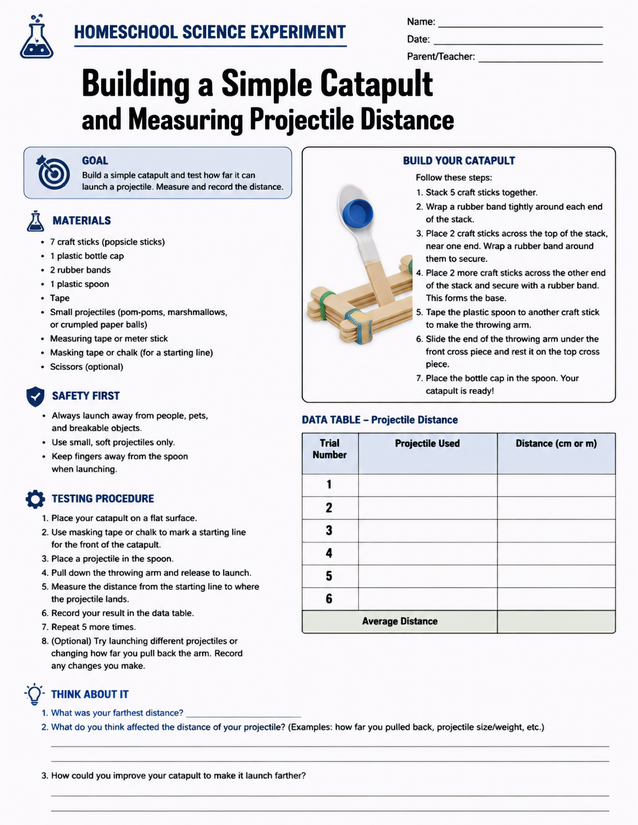
Launch pom-poms, measure distance, and record six trials with this building a simple catapult lab sheet for grades 3 to 5.
Getting Started with Building a Simple Catapult Lab Sheet

Usage Notes
Craft sticks, rubber bands, a plastic spoon, tape, and a bottle cap make up the build, and most households already have them on hand. Small projectiles such as pom-poms, marshmallows, or crumpled paper balls are listed as options, so you can use whatever is available. The sheet includes a dedicated Safety First section reminding students to launch away from people, pets, and breakable objects, and to keep fingers clear of the spoon arm during release.

Printing Tips
Standard 20-pound copy paper is fine for the data table, but a slightly heavier sheet holds up better if students are working on a hard floor or clipboard away from a desk. Print one copy per student rather than laminating, since the data table and reflection lines need to be filled in with different values for each trial run.