Creative Minds 𖹭 Happy Hearts

Simple Electric Circuit with a Battery and Bulb Lab Sheet
Flip a switch and nothing happens, until the loop is complete. A simple electric circuit with a battery and bulb is the hands-on proof your student needs to understand how electricity actually travels.
Your student follows a six-step procedure to build a closed circuit using a single battery, a small flashlight bulb, a bulb holder, and two alligator clip wires. The sheet walks them through connecting the red wire to the positive terminal and the black wire to the negative terminal, then observing whether the bulb lights. A photo of a completed closed circuit is printed right on the sheet for reference, making this simple electric circuit with a battery and bulb experiment clear enough for grades 3 to 5 to run independently with minimal supervision.
An observations section prompts students to record exactly what happened when the circuit closed, and three think-and-answer questions push them further: what happens if one wire is disconnected, why does the bulb turn on, and what they learned overall. The conclusion at the bottom introduces the vocabulary of current flow in plain language, making this lab sheet a strong standalone lesson or a natural opener to a broader electricity unit study.
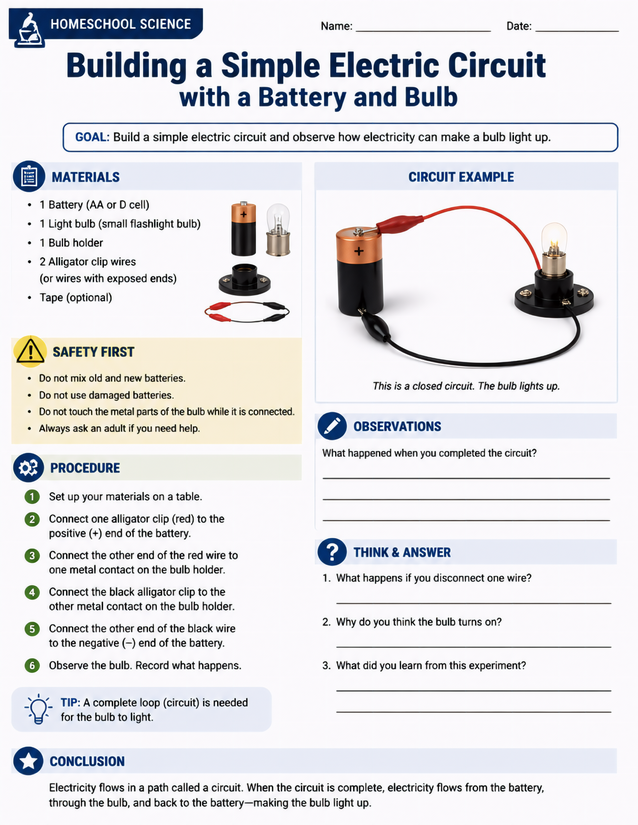
Grades 3 to 5 will love completing this simple electric circuit with a battery and bulb homeschool science lab sheet. Instant download.
Investigating the Simple Electric Circuit with a Battery and Bulb

Usage Notes
One battery (AA or D cell), a small flashlight bulb, a bulb holder, and two alligator clip wires are all your student needs. These are low-cost, widely available items, none of them specialty supplies. The safety panel on the sheet flags four precautions: no mixing old and new batteries, no damaged batteries, no touching metal bulb contacts while connected, and asking an adult for help when needed.

Printing Tips
Weight matters here because students write during the experiment. A 24-pound bond or 32-pound paper holds up better than standard copy weight when a pencil is pressed firmly through multiple answer lines. Loose on a clipboard works well so the sheet can sit beside the materials on the table while your student works.