Creative Minds 𖹭 Happy Hearts

Building a Simple Generator with Coils and Magnets
Spin a coil of copper wire between two magnets and watch an LED flicker to life. Building a simple generator lab sheet makes electromagnetic induction something your student can hold in their hands.
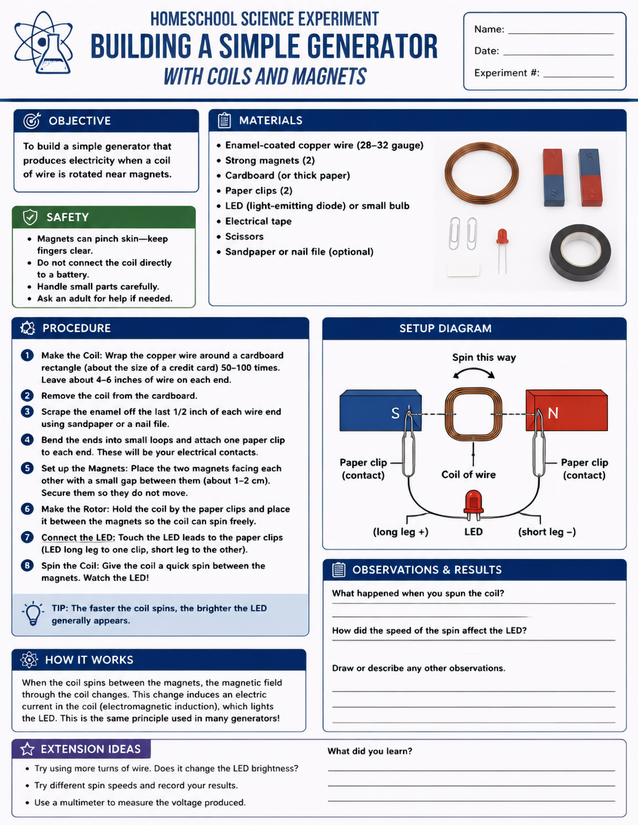
Electromagnetic induction moves from textbook concept to kitchen-table reality with this lab. Your student wraps enamel-coated copper wire around a cardboard rectangle, scrapes the ends clean with sandpaper, attaches paper clips as electrical contacts, and positions two strong magnets facing each other with a small gap. A quick spin of the coil between the magnets changes the magnetic field through the wire, inducing a current that lights a connected LED. The sheet walks through each of those eight steps and closes with a tip that faster spinning produces a brighter light, which naturally prompts your student to test it. Suited for grades 5 through 8, this building a simple generator lab sheet connects directly to physics standards covering energy transfer and electromagnetic induction.
The observations section asks three targeted questions: what happened when the coil spun, how spin speed affected the LED, and an open prompt to draw or describe anything unexpected. Extension ideas push further inquiry, inviting your student to try more wire turns, compare spin speeds, or measure voltage with a multimeter if one is available. As a standalone lab it takes roughly one session to complete, but it slots naturally into a unit study on electricity, magnetism, or energy generation. Completing the sheet demonstrates that your homeschooler can follow a multi-step experimental procedure, record observations against a prediction, and connect a physical result to the principle behind it.
Spin a copper coil between two magnets and light an LED. This building a simple generator lab sheet suits grades 5-8 homeschoolers.
Investigating Building a Simple Generator Lab Sheet

Usage Notes
Most materials here are household or easy to source: cardboard, scissors, and two paper clips are already in most homes. Enamel-coated copper wire in 28 to 32 gauge and an LED are the only specialty items, both inexpensive at hardware or electronics stores. The safety section flags that strong magnets can pinch skin, so supervise younger students when positioning the magnets and remind them not to connect the coil directly to a battery.

Printing Tips
A 24-pound or heavier multipurpose paper keeps the observation lines from buckling when your student writes during the experiment. Print as a loose sheet for clipboard use at the workspace, or hole-punch it to drop straight into a science lab notebook after the session.