Creative Minds 𖹭 Happy Hearts

Building a Simple Radio Receiver, Battery-Free AM Signal Lab
No batteries, no power source, just copper wire, a diode, and a variable capacitor picking AM signals from thin air. Building a simple radio receiver is one of those experiments that still surprises students when sound actually comes through the earphone.
Building a simple radio receiver walks your student through winding a 30-to-40-turn copper coil, connecting a germanium diode and variable capacitor, stringing a long antenna wire, and listening for local AM broadcast stations without any power source at all. The sheet covers the full circuit via a labeled diagram showing the antenna, coil, variable capacitor, diode, and earphone in sequence, and it includes a “Things to Observe” section where students record what changes when they turn the capacitor knob, reposition the antenna, or move to a different room. This lab is suited for grades 5-8 and fits naturally into a unit study on electricity, electromagnetic waves, or the history of radio technology.
The building a simple radio receiver experiment works well as a standalone project or as a capstone after your homeschooler has already explored basic circuits and electromagnetic induction. Completing it demonstrates that students understand how a tuned circuit selects a specific frequency, how a diode rectifies a signal, and why antenna length and placement affect reception. Three reflection prompts at the bottom ask students to articulate what they learned, describe challenges they solved, and name what they would try next, giving you a written record of both the science and the problem-solving process.
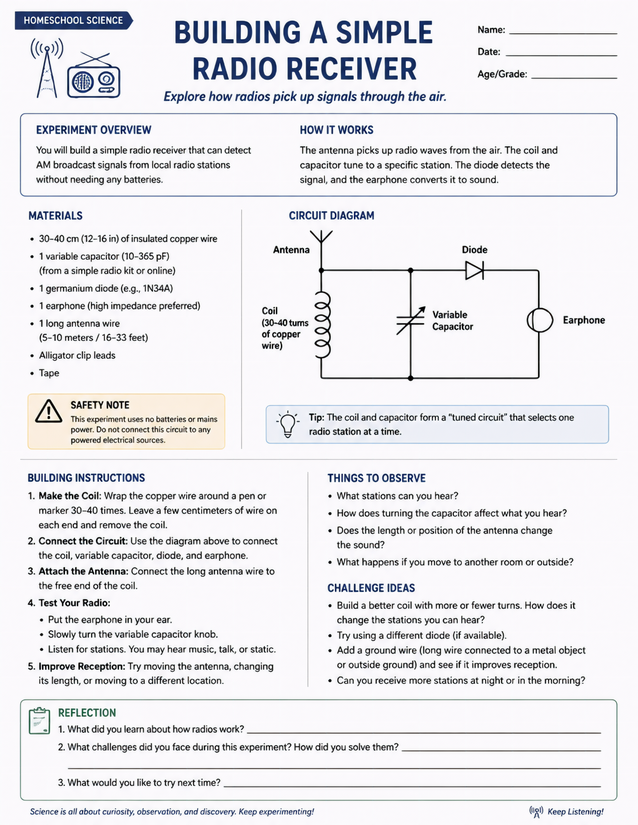
No batteries required: this building a simple radio receiver lab sheet guides grades 5-8 homeschoolers through AM signal detection with a hand-wound coil.
Exploring Building a Simple Radio Receiver Circuit by Circuit

Usage Notes
The materials list calls for insulated copper wire, a variable capacitor (10-365 pF), a 1N34A germanium diode, a high-impedance earphone, a long antenna wire (5-10 meters), alligator clip leads, and tape. The capacitor and diode are the only specialty items; both are available in inexpensive crystal radio kits. The sheet includes a clear safety note: no batteries or mains power are used in this circuit, so the primary caution is simply not connecting the circuit to any powered electrical source.

Printing Tips
Because students write reflection answers and observation notes directly on the sheet, 24-pound paper gives the surface enough tooth to hold pencil or pen without bleed-through. Slip it into a plastic page protector inside a lab notebook so the circuit diagram stays visible while your student builds, then remove it to write the reflection once the experiment is complete.