Creative Minds 𖹭 Happy Hearts

Film Canister Rocket Lab Sheet, Thrust and Air Pressure
Pump air in, step back, and watch the lid pop. This film canister rocket lab sheet turns a 35-minute build into a hands-on lesson on thrust and air pressure.
Your student constructs a nose cone, cuts cardstock fins, and uses a bicycle pump needle to pressurize a film canister until the lid ejects and sends the rocket airborne. The sheet guides ages 8 and up through five numbered build steps and then asks three recorded observations: how many pumps triggered launch, estimated height, and one variable your homeschooler would change to improve the flight. That last question pushes the activity from craft into genuine scientific reasoning, making it a strong fit for grades 3 through 6.
The film canister rocket lab sheet works well as a standalone unit study opener on Newton’s third law or as the hands-on anchor of a broader physics or space science unit. Completing it asks your student to form a hypothesis before launch, collect data during, and propose a follow-up change after, which is a three-stage experimental process in a single session. The built-in safety section reminds parent-teachers to supervise the needle step and keep bystanders clear of the launch area.
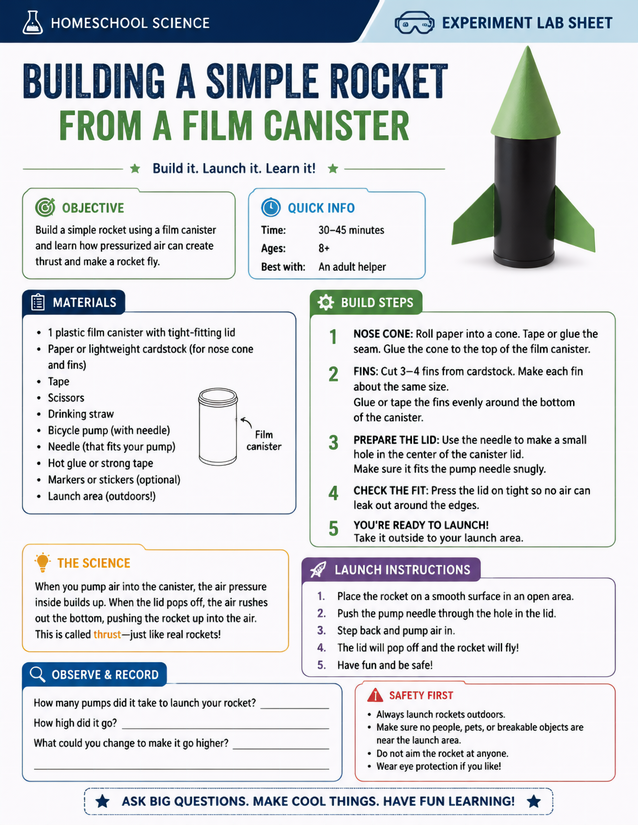
Air pressure launches a real rocket in this film canister rocket lab sheet, suited for homeschoolers ages 8 and up. Instant download.
Recording Results for Your Film Canister Rocket Lab Sheet

Usage Notes
Nearly everything on the materials list is already in a typical homeschool supply drawer: tape, scissors, a drinking straw, markers, and lightweight cardstock. The two specialty items are a plastic film canister with a tight-fitting lid and a bicycle pump with a needle attachment, which are available inexpensively online. Because the needle step requires puncturing the lid, plan to supervise that step closely and move the entire launch sequence outdoors.
Printing Tips
A 28-pound paper handles the writing sections without buckling under pencil pressure during the observe-and-record portion. Print a single loose sheet to clip to a board your student can carry to the launch area, keeping notes right at the experiment site.