Creative Minds 𖹭 Happy Hearts

Building a Simple Telegraph Lab Sheet, Morse Code Included
Dots and dashes come to life when your student presses a buzzer key to send real Morse code. This building a simple telegraph lab sheet turns a battery and three wires into a working communication device.
Your student builds a functioning telegraph circuit using a 1.5V battery, a push button switch, a 3V buzzer, and alligator clip jumper wires, then uses it to send actual Morse code messages. The sheet walks through the circuit assembly in seven numbered steps, includes a full-alphabet Morse code chart, and closes with four Think and Reflect questions asking what happens when the key is pressed, what happens when it is released, how telegraphs were used historically, and a challenge to send a name in Morse code. Suited for grades 4 to 6, this building a simple telegraph lab sheet sits squarely in an electricity and circuits unit.
The sheet works well as a standalone experiment or as the applied follow-up after your homeschooler has studied basic open and closed circuits. Completing it demonstrates understanding of circuit continuity, the relationship between a switch and current flow, and the real-world application that drove 19th-century communication. The included sending code guide and Morse chart mean no supplemental materials are needed for the messaging portion of the lesson.
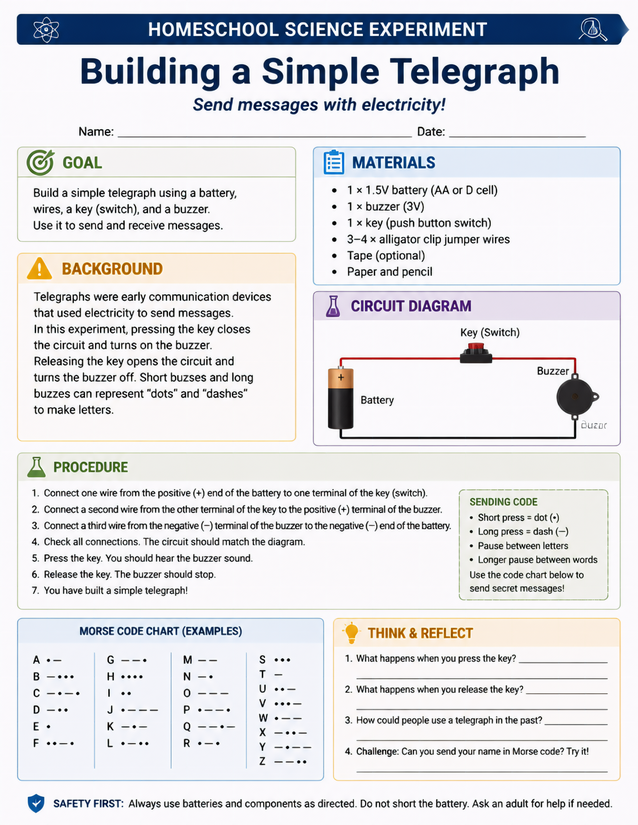
Grades 4-6 homeschoolers explore basic circuits with this building a simple telegraph lab sheet, complete Morse code chart included.
Setting Up Your Building a Simple Telegraph Lab Sheet

Usage Notes
The materials list calls for a 1.5V battery (AA or D cell), a 3V buzzer, a push button switch, three to four alligator clip jumper wires, tape, and paper and pencil. The buzzer and alligator clips are the only specialty items here; everything else is standard household stock. The sheet includes a safety note reminding students not to short the battery and to ask an adult for help, so review that with your student before assembly begins.

Printing Tips
Slip a loose sheet onto a clipboard so your student can reference the circuit diagram and check off procedure steps while both hands are occupied with wires and components. Standard 20-pound copy paper is fine since the writing sections are short fill-in responses rather than long-form notes.