Creative Minds 𖹭 Happy Hearts

Building a Simple Weather Station with Barometer, Thermometer, and Rain Gauge
Balloon over a jar, a cut plastic bottle, a thermometer mounted in the shade: building a simple weather station turns everyday materials into a working instrument set your student checks daily.
Building a simple weather station gives grades 4 through 6 students a hands-on look at three core meteorology instruments. The sheet walks your homeschooler through constructing an aneroid-style barometer from a balloon and jar, mounting a thermometer in a shaded spot, and cutting a plastic bottle into a rain gauge marked in millimeters. A weather log table at the bottom asks students to record date, barometer reading, temperature in Celsius and Fahrenheit, rainfall in millimeters, general conditions, and notes, building a real data set over multiple days.
This lab works well as an anchor project in a weather or earth science unit study, running across a week or more as students look for patterns between air pressure and incoming weather. Completing the log demonstrates observation, consistent measurement, and basic data interpretation, skills that transfer directly into later science coursework. The Think and Extend prompt at the bottom invites your student to add a wind vane or cloud chart, making it easy to expand the project if your homeschool schedule allows.
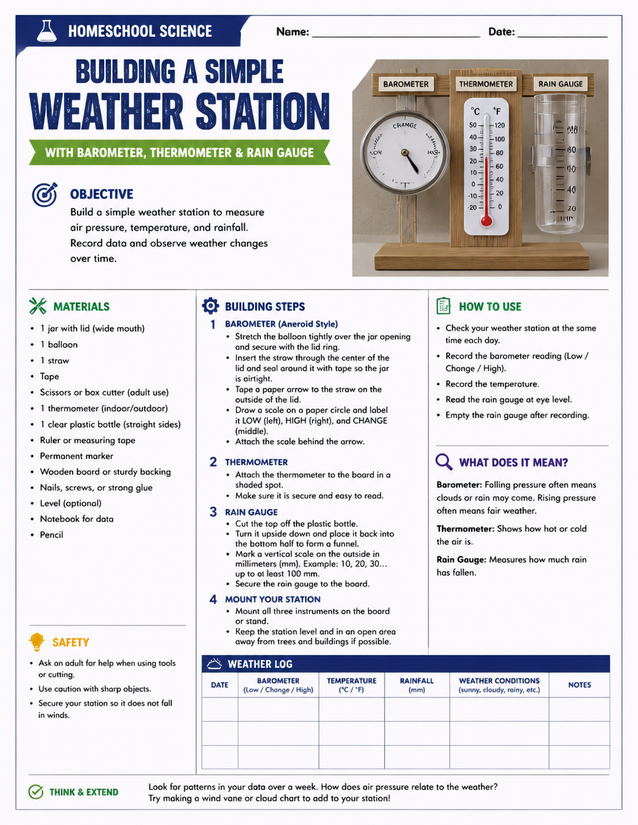
Air pressure, temperature, and rainfall all tracked in one project: building a simple weather station suits grades 4 through 6 homeschoolers perfectly.
Getting Started with Building a Simple Weather Station

Usage Notes
Most of what your student needs is already at home: a wide-mouth jar, a balloon, a straw, tape, scissors, a clear plastic bottle with straight sides, a ruler, and a permanent marker. The one specialty item is an indoor/outdoor thermometer, which is inexpensive and reusable across many lessons. Adult supervision is noted for any cutting steps involving scissors or a box cutter.

Printing Tips
Standard 20-pound copy paper works for most sections, but the weather log table at the bottom will see daily pencil and eraser use, so 24-pound or cardstock holds up better over a week of repeated entries. Keep it as a loose sheet on a clipboard near the station so your student can record readings at the same time each day without hunting for a notebook.