Creative Minds 𖹭 Happy Hearts

Building a Simple Wind Turbine Lab Sheet, Grades 4-6
Cups become blades, a pencil becomes a tower, and building a simple wind turbine turns a fan into a power source your student built themselves.
Building a simple wind turbine walks your student through engineering a functional generator from paper cups, a small DC motor, alligator clip wires, and an LED. The data table asks them to record blade design variables like shape, number, and angle alongside whether the LED lit up, making this a genuine test-and-improve loop rather than a one-and-done build. It suits grades 4 through 6 and fits naturally into a homeschool energy or engineering unit.
Because the procedure runs five distinct steps, from blade construction through circuit connection to iterative redesign, this sheet works well as the hands-on anchor of a renewable energy unit study. Your homeschooler demonstrates understanding of energy conversion by the time they fill in the reflection section, answering what worked, what they would change, and how a wind turbine actually produces electricity.
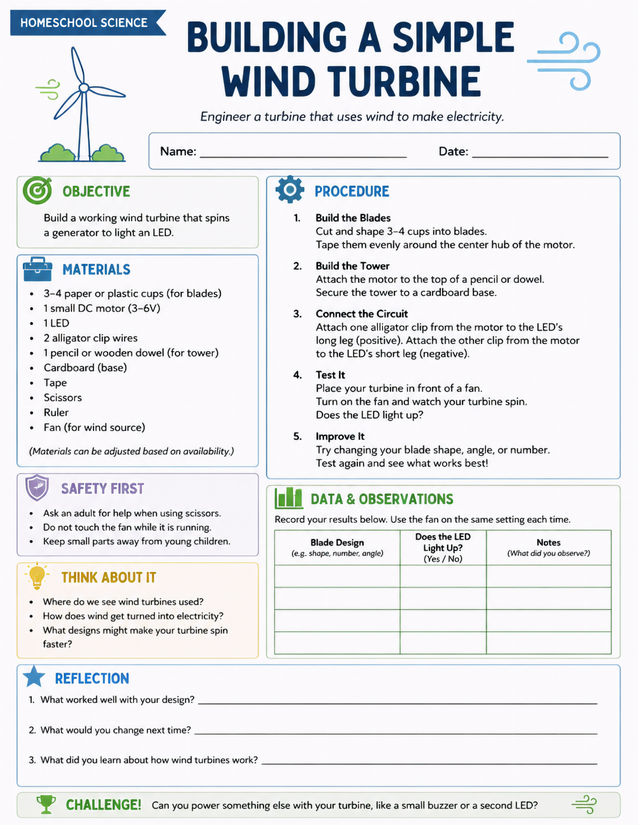
Cup blades, a DC motor, and an LED: the building a simple wind turbine lab sheet guides grades 4-6 homeschoolers through real circuit work.
Investigating Building a Simple Wind Turbine, Blade by Blade

Usage Notes
Paper or plastic cups, a pencil or wooden dowel, cardboard, tape, scissors, and a ruler are all household items. The one specialty supply is a small DC motor rated 3 to 6V, available inexpensively from hobby or electronics suppliers. The safety section flags scissors use, a running fan, and small parts around young children, so plan to work alongside your student during the build steps.

Printing Tips
Standard copy paper works for a one-time build session, but 32-pound paper holds up better if your student is erasing and revising the data table mid-experiment. Punch holes along the left edge and slip it straight into a science lab notebook so the reflection section stays with the experiment record.