Creative Minds 𖹭 Happy Hearts

Building a Small Greenhouse from Plastic Bottles, 7-Day Lab
Two clear bottles, some potting soil, and a handful of seeds turn into a controlled plant growth experiment. Building a small greenhouse from plastic bottles gives your student a hands-on look at how trapped heat and moisture affect living things.
Your student will investigate how an enclosed environment changes temperature and plant development compared to an open control. The sheet guides grades 4 to 6 through a structured 7-day experiment: both bottles receive the same seeds, the same soil, and the same watering, but one is sealed with its cap to act as a mini greenhouse while the other stays open to the air. Daily temperature readings go into the data table alongside observations on plant growth, leaf development, and moisture. Building a small greenhouse from plastic bottles makes the greenhouse effect visible and measurable rather than abstract.
This lab fits naturally into a unit study on plant biology, ecosystems, or climate science, and works just as well as a standalone investigation. Four conclusion questions ask your student to compare results, explain the temperature difference, and reflect on what they would change in a second run. Completing the sheet demonstrates controlled experiment design, daily data collection, and evidence-based reasoning, skills that carry forward into more advanced science work.
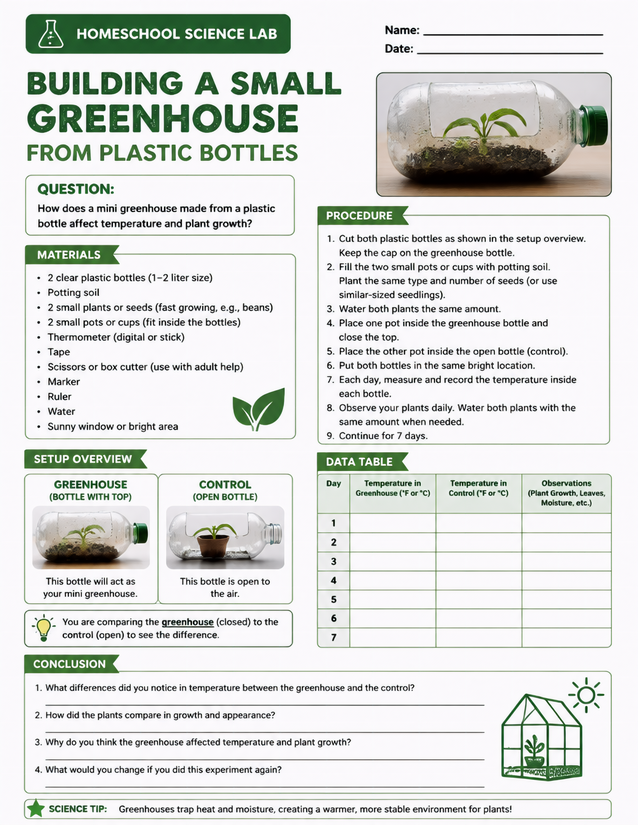
Grades 4-6 homeschoolers test heat and plant growth using building a small greenhouse from plastic bottles over seven days.
Investigating Building a Small Greenhouse from Plastic Bottles

Usage Notes
Every item on the materials list is a household or grocery-store find: two 1 to 2 liter clear plastic bottles, potting soil, fast-growing seeds such as beans, small pots or cups, a thermometer, tape, and a marker. Scissors or a box cutter are needed to cut the bottles, so the sheet flags adult help for that step. No specialty supplies are required, which makes this easy to prep without a trip to a science supply store.

Printing Tips
Standard 20-pound copy paper works for most students, but 24-pound paper holds up better if the sheet gets splashed during watering checks. Keep it as a loose page on a clipboard next to the bottles so your student can record temperature readings quickly each day without moving the experiment.