Creative Minds 𖹭 Happy Hearts

Building a Trebuchet to Study Angular Momentum, Lab Sheet
Counterweights, pivot points, and flying projectiles make the trebuchet angular momentum lab sheet one of the most memorable physics experiments your homeschooler will run.
Your student builds a functioning trebuchet from wood or popsicle sticks, then uses this trebuchet angular momentum lab sheet to investigate how changing counterweight mass and lever arm distance affects both moment of inertia and how far the projectile flies. The sheet walks through background on the formula L = Iω, a structured hypothesis section, a four-trial data table recording counterweight mass, counterweight distance from pivot, and launch distance, and four analysis questions that ask students to connect results to the concept of angular momentum. This experiment suits grades 5-8 and works especially well within a physics unit covering rotational motion or classical mechanics.
As a standalone unit study activity, this lab sheet gives your homeschooler a complete experimental sequence from building to testing to calculating. The optional step asking students to estimate moment of inertia using I = mr² pushes the sheet toward upper middle school or early high school level work. Completing it demonstrates that your student can control variables, average repeated trials, and reason from data back to a physical principle, which is exactly the kind of hands-on learning that makes abstract formulas stick.
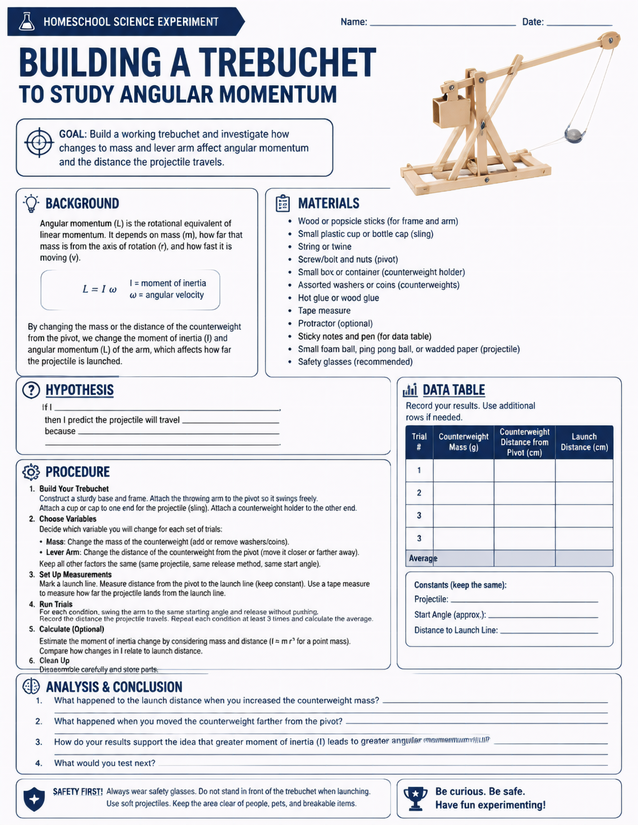
Your student tests how mass and lever arm affect launch distance using this trebuchet angular momentum lab sheet, designed for grades 5-8.
Investigating the Trebuchet Angular Momentum Lab Sheet

Usage Notes
Safety glasses are listed as recommended and should be treated as required when launching any projectile indoors or near people. Most structural materials are household or craft supplies: popsicle sticks, string, a small plastic cup, assorted washers or coins, and hot glue. A protractor and tape measure are the only slightly specialty items, and most homeschool households already have both.

Printing Tips
At least two copies per student is smart here, one for drafting hypothesis and recording live trial data on a clipboard during the build, and a clean second copy for final recorded results to insert into a lab notebook. Standard copy paper holds up fine for dry tabletop recording, but if your student tends to work messily during builds, 32-pound paper resists wrinkles better.