Creative Minds 𖹭 Happy Hearts

Building a Working Jacob’s Ladder Toy, With Batteries
Flames climbing a copper-wire ladder powered by AA batteries, building a working Jacob’s Ladder toy is one of those experiments your student will talk about for weeks.
Building a working Jacob’s Ladder toy puts electricity, arcing, and circuit behavior into one memorable hands-on experiment suited for grades 5 through 7. The lab sheet walks your student through the full process, from forming a hypothesis about why the flame climbs upward, to recording six specific observations in a yes/no table covering whether the flame starts at the bottom, moves upward, jumps rung to rung, and whether the rods or wires get hot.
This sheet works well as a standalone unit in a physics or electricity sequence, and the Extend Your Learning prompt connects the arc behavior to real-world applications like welding or plasma torches. By completing the conclusion section, your homeschooler demonstrates understanding of how electricity jumps a gap and why that creates the illusion of an upward-climbing flame, which is the core concept behind building a working Jacob’s Ladder toy.
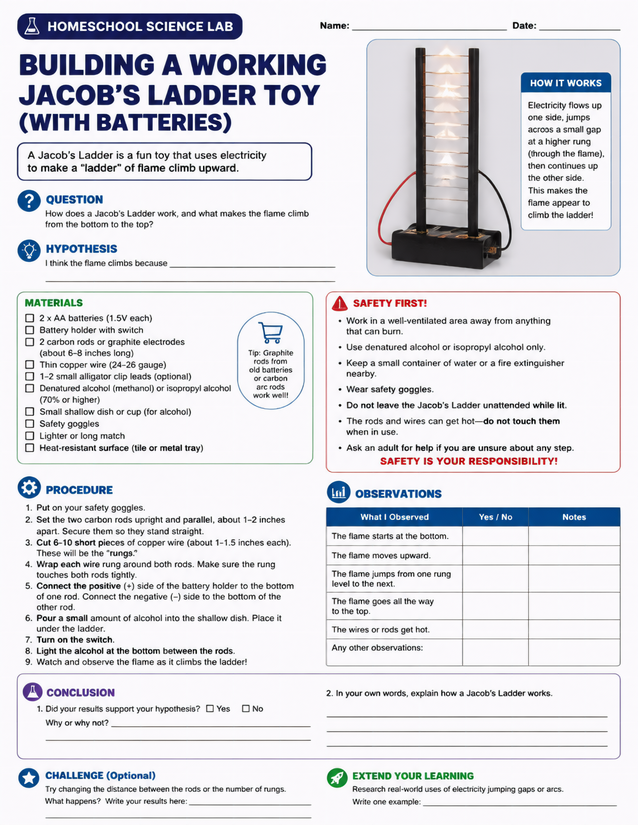
Flames climb copper rungs when building a working Jacob’s Ladder toy. Grades 5-7 homeschool electricity lab, ready to print.
Investigating Building a Working Jacob’s Ladder Toy, Rung by Rung

Usage Notes
Alcohol is on the materials list, specifically denatured methanol or isopropyl at 70 percent or higher, which makes adult supervision non-negotiable for this experiment. Carbon rods or graphite electrodes, around 6 to 8 inches long, are the specialty item here. The sheet notes that graphite rods from old batteries or carbon arc rods work well, and the remaining supplies (AA batteries, copper wire, alligator clips, a shallow dish) are standard household or hardware-store finds.

Printing Tips
A single loose sheet on a clipboard keeps the observations table flat and easy to mark during the experiment without risking damage to a lab notebook near an open flame. Use 24-pound copy paper or heavier so pencil marks stay legible if the sheet picks up any moisture from the alcohol dish nearby.