Creative Minds 𖹭 Happy Hearts

Growing a Potato from an Eye Cutting Lab Sheet
One potato, one pot, one question worth watching unfold over days: growing a potato from an eye cutting is one of the most tangible introductions to asexual plant reproduction a homeschooler can do.
Growing a potato from an eye cutting anchors the concept of vegetative propagation in something your student can hold, plant, and check on every morning. The sheet walks through the experiment question, a seven-step procedure, and a dated observation table where students record what they see as the cutting develops. Background text explains that potato eyes contain buds capable of producing an entirely new plant, connecting the hands-on activity to the biology concept of asexual reproduction. This suits grades 3 to 6 and pairs naturally with a plant biology unit or a broader life science sequence.
As a standalone lab, growing a potato from an eye cutting works well even outside a formal unit study because the procedure is self-contained and the observation period stretches over several days, giving your homeschooler repeated practice noticing and recording change. A conclusion section asks what happened and what was learned, prompting your student to synthesize the result rather than just describe it. Completing the sheet demonstrates understanding of plant propagation, basic experimental structure, and how to keep a running scientific record.
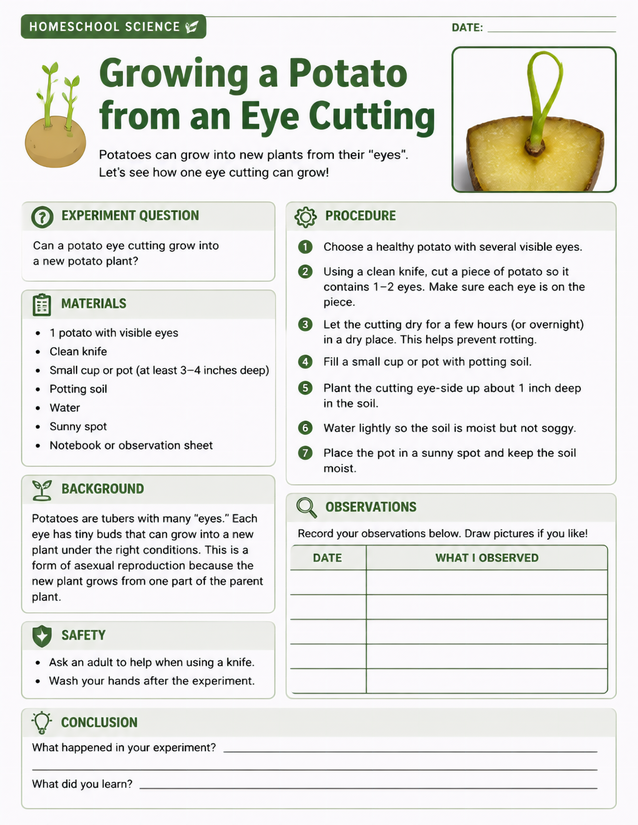
Grades 3 to 6 will love growing a potato from an eye cutting and recording observations in this homeschool science experiment sheet.
Recording Results for Growing a Potato from an Eye Cutting

Usage Notes
Every material on this list is a household or garden-center staple: a potato with visible eyes, a clean knife, a small pot at least three to four inches deep, potting soil, water, and a sunny windowsill. The sheet explicitly notes that an adult should assist with the knife step, so plan to supervise that moment directly. No specialty supplies are needed, which makes this one of the lowest-barrier experiments in a plant biology unit.
Printing Tips
Cardstock holds up better than copy paper if your student plans to rest the sheet on a pot edge or damp surface while recording daily observations. Slide the completed sheet into a plastic page protector inside a science binder so the observation table stays readable even if it catches a splash during watering.