Creative Minds 𖹭 Happy Hearts

Growing Algae in a Homemade Bioreactor, Lab Sheet
Bright green water bubbling in a plastic bottle is not an accident. Growing algae in a homemade bioreactor turns a two-liter bottle into a living, oxygen-producing science experiment.
This lab guides your student through building a functioning bioreactor from a clear plastic bottle, air tubing, and an aquarium pump, then culturing live algae over multiple days. The observation table asks students to record color, clarity, and algae amount daily, while a graph grid helps them visualize growth over time. Suited for grades 5 through 8, the sheet connects photosynthesis, nutrient cycles, and basic biology in one sustained investigation. Growing algae in a homemade bioreactor fits naturally into a life science or ecology unit study, and the three analysis questions push students to think about variables and improvements rather than just copying down data. Completed over one to two weeks, it demonstrates that your homeschooler can design, monitor, and evaluate a living system from start to finish.
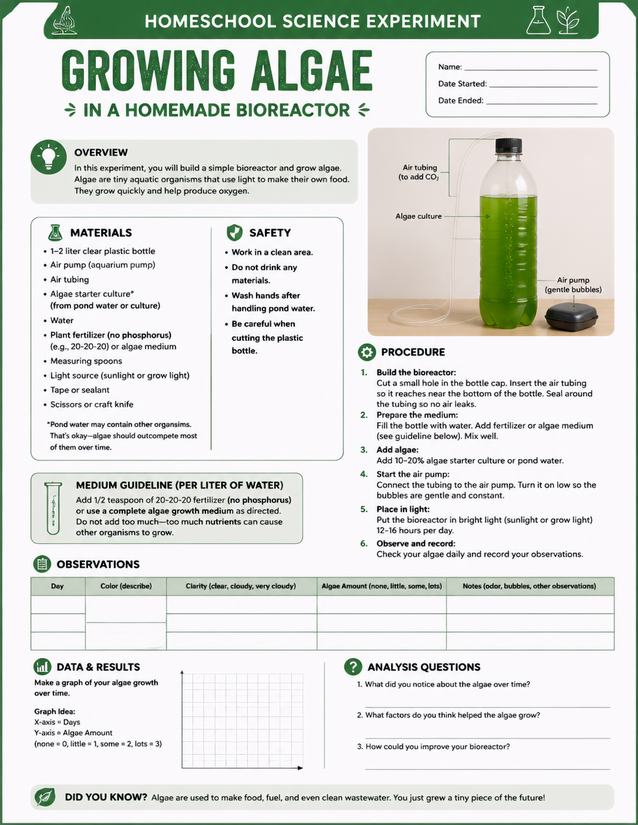
Growing algae in a homemade bioreactor teaches photosynthesis hands-on for grades 5 through 8. Includes daily observation table and analysis questions.
Investigating Growing Algae in a Homemade Bioreactor

Usage Notes
An aquarium pump and air tubing are the only specialty items here. The bottle, water, measuring spoons, scissors, tape, and a light source are standard household supplies, and the fertilizer called for is a no-phosphorus plant fertilizer such as 20-20-20. A craft knife is listed for cutting the bottle cap, so adult supervision is specifically noted on the sheet for that step.

Printing Tips
Twenty-four-pound paper gives the observation table enough body to write on without the sheet buckling when it sits near a wet bioreactor. Punch and insert it into a dedicated science lab notebook so daily entries stay in sequence alongside your student’s graph.