Creative Minds 𖹭 Happy Hearts

Growing Avocado Trees from Pits, Comparing Growth Rates
Growing avocado trees from pits turns a kitchen scrap into a months-long science experiment your homeschooler will actually want to check on every day.
This lab sheet guides students through suspending three to five avocado pits over water using toothpicks and glass jars, then measuring sprout height and root length in centimeters across up to five pits over six to eight weeks. The data table tracks both measurements for each pit by date, making it well suited for grades 3 through 5 as an introduction to controlled variables, plant biology, and interpreting simple growth data over time.
Growing avocado trees from pits fits naturally into a botany or plant life cycle unit study, and it works as a standalone long-term observation project that runs alongside other lessons. By the end, your student has a completed data table, written responses to five analysis questions comparing which pit sprouted fastest and why some pits may not sprout at all, and a short written conclusion drawn from their own measurements.
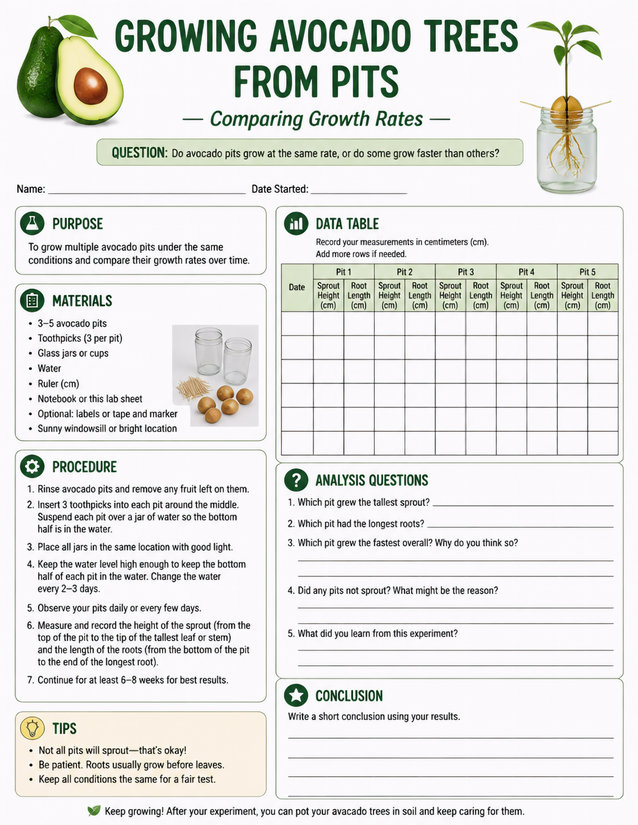
Growing avocado trees from pits has never been more organized for grades 3 through 5. Track sprout height and root length across five pits.
Recording Results for Growing Avocado Trees from Pits

Usage Notes
Avocado pits, toothpicks, glass jars or cups, water, and a ruler in centimeters are all the sheet requires, and every item is a household staple or easy grocery store find. Three toothpicks per pit hold each seed suspended over water, so no specialty supplies are needed at all. No heat, chemicals, or sharp tools are involved, making this a genuinely low-supervision setup once the jars are arranged in a sunny spot.

Printing Tips
Twenty-four-pound paper gives the data table enough body to handle repeated writing sessions over several weeks without buckling. Punch holes and add it to a science binder so your student can flip back to earlier entries while filling in new measurements.